The Pyramid of Cestius, Rome (c. 1650–80): Art, History and Details
The Pyramid of Cestius, Rome at the Cleveland Museum of Art: c. 1650–80, Pen and brown ink with red chalk on brown prepared paper. Explore the work's context, creator attribution and collection history.
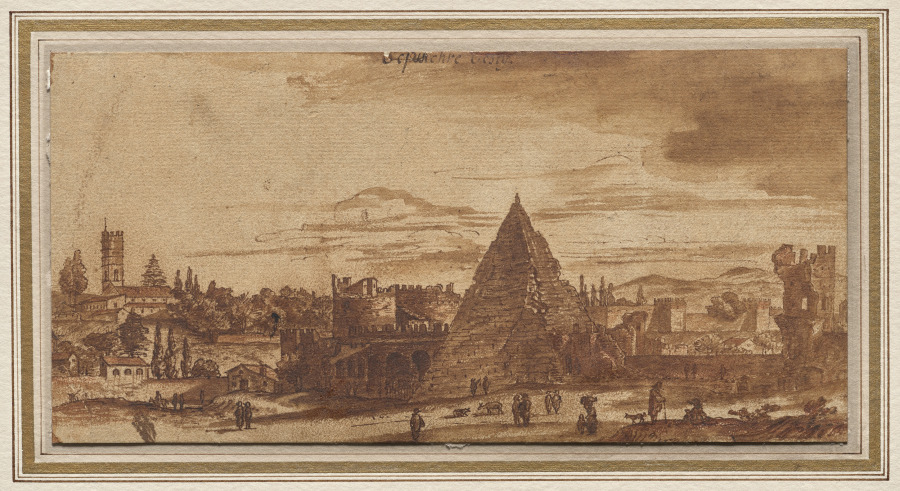
The Pyramid of Cestius, Rome (c. 1650–80) is in the Cleveland Museum of Art collection. The museum's creator attribution is Michiel van Overbeek (Dutch, active 1663–1709).
The work and its context
The museum's open-access catalogue describes the work:
The Dutch artist Michiel Van Overbeek drew The Pyramid of Cestius, Rome from southwest of the site, looking toward the 12 BC Pyramid of Cestius, and the 3rd- to 4th-century Porta Ostiensis (Porta Santo Paulo). The Egyptian structure in the Roman countryside attracted many tourists, and artists, for its singularity within the Roman architectural landscape. The careful attention given to the rise of the land at left, with small abodes tucked into the hills, and the crumbling ruin at the right, suggest that Van Overbeek wanted to record the scene as accurately as possible.
Object facts
- Title: The Pyramid of Cestius, Rome
- Date: c. 1650–80
- Creator attribution: Michiel van Overbeek (Dutch, active 1663–1709)
- Culture: Netherlands
- Type: Drawing
- Technique: Pen and brown ink with red chalk on brown prepared paper
- Dimensions: Support: 18.1 x 28.3 cm (7 1/8 x 11 1/8 in.); Matted: 21.9 x 30.5 cm (8 5/8 x 12 in.); Image: 9.9 x 20 cm (3 7/8 x 7 7/8 in.)
- Collection: DR - Dutch
- Department: Drawings
- Accession number: 2021.144
A detail from the museum
The Pyramid of Cestius was constructed in Rome as a tomb in 12 BC during a fad for Egyptian things just a few years after Rome had conquered Cleopatra’s Egypt (30 BC).
Collection credit
Mr. and Mrs. Richard W. Whitehill Art Purchase Endowment Fund
Further reading listed by the museum
- P. & D. Colnaghi & Co. Art in Seventeenth Century Italy. Colnaghi & Co's Galleries. Catalogues. 1972. London: P. & D. Colnaghi, 1972.
View the collection record
See the museum's photographs and full catalogue entry. Catalogue text is reproduced from the Cleveland Museum of Art's open-access data, with HTML formatting removed. This object and its supplied image are designated CC0.
Sources
More in Lifestyle
Keep reading