The Secret Five Bodhisattvas (Gohimitsu Bosatsu) (1200s): Art, History and Details
The Secret Five Bodhisattvas (Gohimitsu Bosatsu) at the Cleveland Museum of Art: 1200s, hanging scroll; ink, color, gold, and silver on silk. Explore the work's context, creator attribution and collection history.
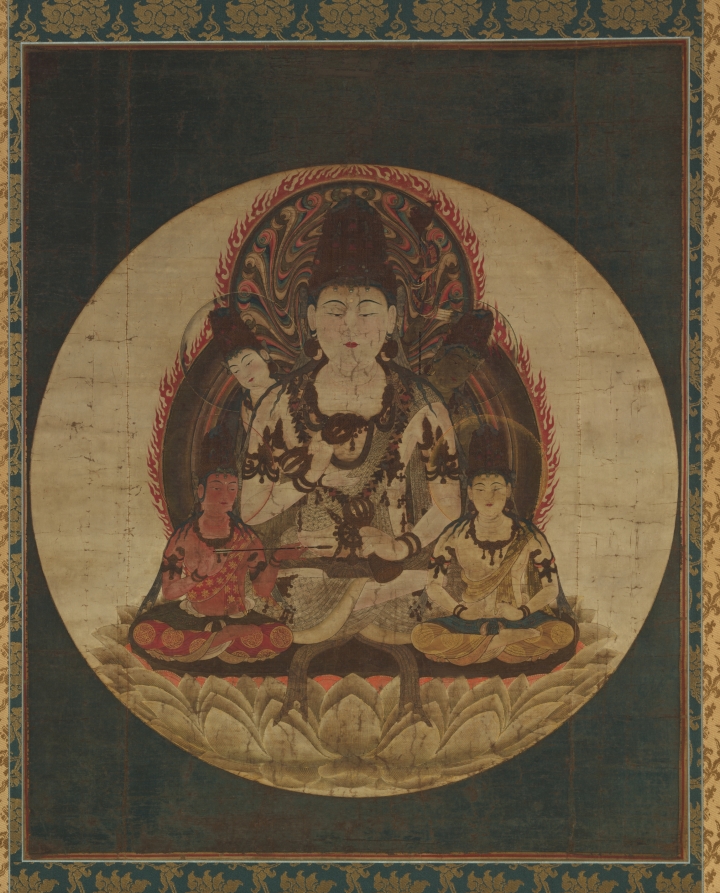
The Secret Five Bodhisattvas (Gohimitsu Bosatsu) (1200s) is in the Cleveland Museum of Art collection.
The work and its context
The museum's open-access catalogue describes the work:
The Secret Five were used in a Buddhist ritual to convert negative aspects of consciousness into positive ones. At the center is Kongōsatta, who represents the enlightened mind. He is surrounded by enlightened beings who convert the human frailties of desire, sensory pleasure, passion, and pride into constructive tools to use on the path to enlightenment.
Object facts
- Title: The Secret Five Bodhisattvas (Gohimitsu Bosatsu)
- Date: 1200s
- Culture: Japan, Kamakura period (1185–1333)
- Type: Painting
- Technique: hanging scroll; ink, color, gold, and silver on silk
- Dimensions: Image: 78.1 x 63.5 cm (30 3/4 x 25 in.); Overall: 163.2 x 83.8 cm (64 1/4 x 33 in.)
- Collection: ASIAN - Hanging scroll
- Department: Japanese Art
- Accession number: 1961.423
A detail from the museum
The bodhisattva Kongōsatta wears a crown containing figures of the Five Wisdom Buddhas.
Collection credit
Mr. and Mrs. William H. Marlatt Fund
Further reading listed by the museum
- Cleveland Museum of Art, “Gohimitsu Bosatsu,” August 15, 1962, Cleveland Museum of Art Archives.
- Lee, Sherman E. “The Secret Five.” The Bulletin of the Cleveland Museum of Art 49, no. 7 (September 1962): 157–166.
- The Cleveland Museum of Art. Handbook of the Cleveland Museum of Art/1966. Cleveland, OH: The Cleveland Museum of Art, 1966.
View the collection record
See the museum's photographs and full catalogue entry. Catalogue text is reproduced from the Cleveland Museum of Art's open-access data, with HTML formatting removed. This object and its supplied image are designated CC0.
Sources
More in Lifestyle
Keep reading