The Sibyls: The Phrygian Sibyl (c. 1470–80): Art, History and Details
The Sibyls: The Phrygian Sibyl at the Cleveland Museum of Art: c. 1470–80, engraving. Explore the work's context, creator attribution and collection history.
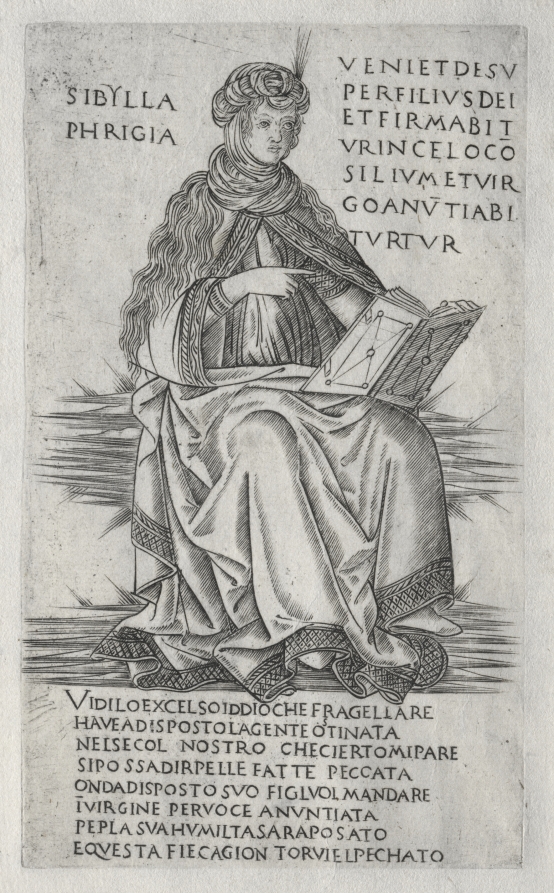
The Sibyls: The Phrygian Sibyl (c. 1470–80) is in the Cleveland Museum of Art collection. The museum's creator attribution is Francesco Rosselli (Italian, 1448-about 1513).
The work and its context
The museum's open-access catalogue describes the work:
Florence, Italy, was a center for metalwork and paper manufacturing—and, thus, also for early engraving. To engrave a set of prophets and sibyls (ancient seer women), Baccio Baldini used traditional Italian goldsmith’s tools, including burins with both square- and round-shaped sections: square for the fine lines, and round for the broad ones. Francesco Rosselli created this similar set of sybils and prophets but used a new tool, a burin with a lozenge-shaped tip, which he may have acquired in Northern Europe (see examples of these tools across the hall). The new burin produced lines that held more ink; the most deeply cut lines also wore down at a slower pace, extending the plate’s lifespan. Rosselli may have copied Baldini’s subjects specifically to demonstrate the new tool’s merits.
Object facts
- Title: The Sibyls: The Phrygian Sibyl
- Date: c. 1470–80
- Creator attribution: Francesco Rosselli (Italian, 1448-about 1513)
- Culture: Italy, Florence
- Type: Print
- Technique: engraving
- Collection: PR - Engraving
- Department: Prints
- Accession number: 1943.388
Collection credit
Purchase from the J. H. Wade Fund
Further reading listed by the museum
- Francis, Henry. "Florentine Engravings of the Fifteenth Century." The Bulletin of the Cleveland Museum of Art 38, no. 3 (March 1951): 63-65.
View the collection record
See the museum's photographs and full catalogue entry. Catalogue text is reproduced from the Cleveland Museum of Art's open-access data, with HTML formatting removed. This object and its supplied image are designated CC0.
Sources
More in Lifestyle
Keep reading