The snake enters into an argument with the frog, from a Tuti-nama (Tales of a Parrot): Twenty-sixth Night (c. 1560): Art, History and Details
The snake enters into an argument with the frog, from a Tuti-nama (Tales of a Parrot): Twenty-sixth Night at the Cleveland Museum of Art: c. 1560, gum tempera, ink, and gold on paper. Explore the work's context, creator attribution and coll
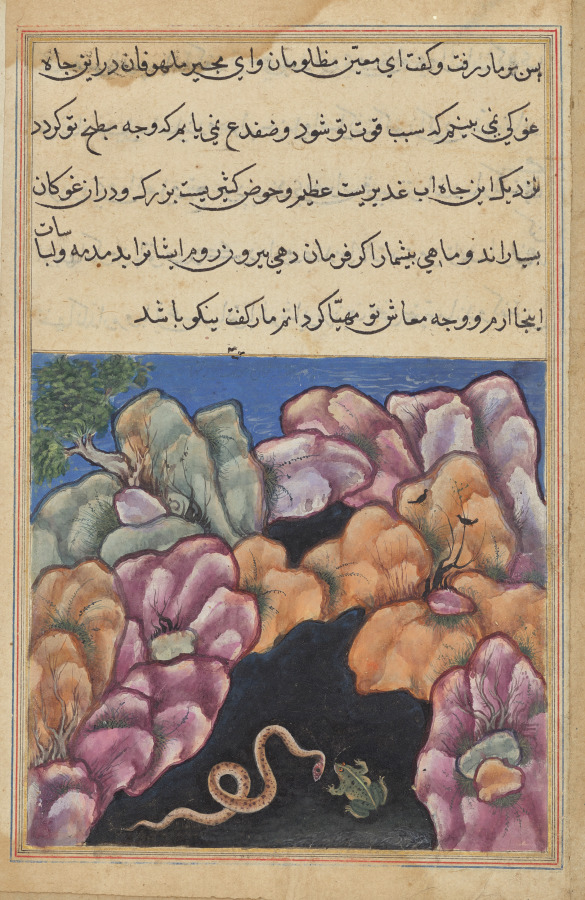
The snake enters into an argument with the frog, from a Tuti-nama (Tales of a Parrot): Twenty-sixth Night (c. 1560) is in the Cleveland Museum of Art collection.
The work and its context
The museum's open-access catalogue describes the work:
Cave compositions were replicated for multiple types of scenes in India, based on Persian models like the Shah-nama painting CMA 1988.96.a. The black background of the caves in the Tuti-nama provides the viewer a window into a subterranean space, the mouth of which is shown amid the rocks above. Shapur, the exiled frog tyrant, asked a snake to devour his enemies. However, when the snake became hungry again, he ate Shapur’s friends and family. Without any subjects to rule, the frog escaped his dangerous ally and lived out his life, sad and alone.
Object facts
- Title: The snake enters into an argument with the frog, from a Tuti-nama (Tales of a Parrot): Twenty-sixth Night
- Date: c. 1560
- Culture: Mughal India, court of Akbar (reigned 1556–1605)
- Type: Painting
- Technique: gum tempera, ink, and gold on paper
- Dimensions: Overall: 20.3 x 14 cm (8 x 5 1/2 in.); Painting only: 9.5 x 10.2 cm (3 3/4 x 4 in.)
- Collection: Indian Art
- Department: Indian and Southeast Asian Art
- Accession number: 1962.279.183.b
A detail from the museum
The story takes place in China.
Collection credit
Gift of Mrs. A. Dean Perry
View the collection record
See the museum's photographs and full catalogue entry. Catalogue text is reproduced from the Cleveland Museum of Art's open-access data, with HTML formatting removed. This object and its supplied image are designated CC0.
Sources
More in Lifestyle
Keep reading