The wolf advises the lion to consult the cat, from a Tuti-nama (Tales of a Parrot): Fifteenth Night (c. 1560): Art, History and Details
The wolf advises the lion to consult the cat, from a Tuti-nama (Tales of a Parrot): Fifteenth Night at the Cleveland Museum of Art: c. 1560, gum tempera, ink, and gold on paper. Explore the work's context, creator attribution and collection
The wolf advises the lion to consult the cat, from a Tuti-nama (Tales of a Parrot): Fifteenth Night (c. 1560) is in the Cleveland Museum of Art collection.
The work and its context
The museum's open-access catalogue describes the work:
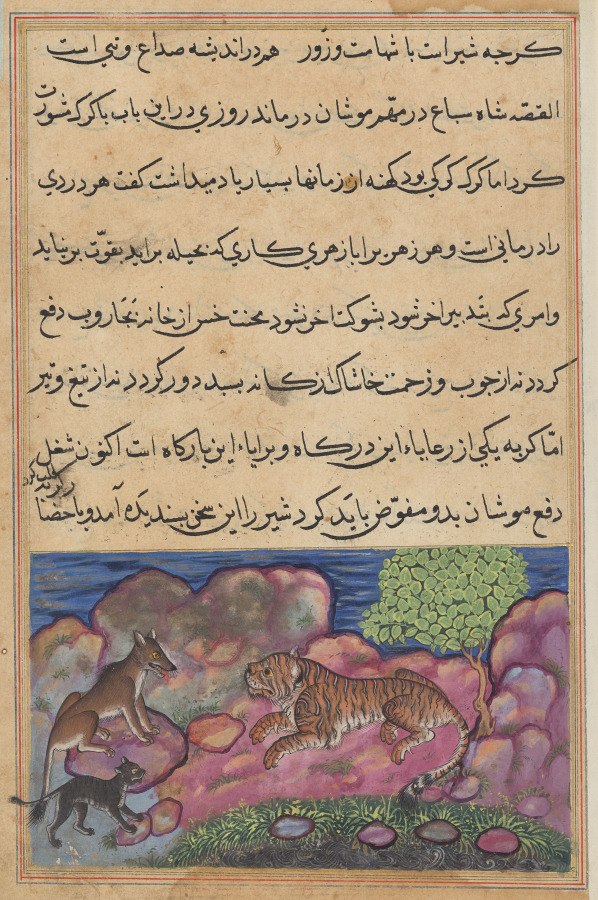
The painting depicts an old tiger, crouching under a tree by a stream looking plaintively at a wolf, with whom he has just shared his troubles with the mice. The wolf suggested that the cat be called to eliminate the mice. The cat has dutifully arrived and requests that he be given the position of Magistrate of the Court, to which the lion agreed. The cat instilled fear in the mice; they dispersed, and the lion was content. Wisely, however, the cat treated the mice with consideration and did not exterminate them completely, so that he would not eliminate the cause of his usefulness. Although the rocky landscape is heavily shaded in a technique that gives them a soft quality, and the leaves of the tree are each outlined in gold, the lack of any actual shadows from an identifiable light source provides a timeless appearance to the scene.
Object facts
- Title: The wolf advises the lion to consult the cat, from a Tuti-nama (Tales of a Parrot): Fifteenth Night
- Date: c. 1560
- Culture: Mughal India, court of Akbar (reigned 1556–1605)
- Type: Painting
- Technique: gum tempera, ink, and gold on paper
- Dimensions: Overall: 20.3 x 14 cm (8 x 5 1/2 in.); Painting only: 6 x 10.3 cm (2 3/8 x 4 1/16 in.)
- Collection: Indian Art
- Department: Indian and Southeast Asian Art
- Accession number: 1962.279.114.a
A detail from the museum
The same word is used in Persian for both “lion” and “tiger.”
Collection credit
Gift of Mrs. A. Dean Perry
Further reading listed by the museum
- Chandra, Pramod, and Daniel J. Ehnbom. The Cleveland Tuti-Nama Manuscript and the Origins of Mughal Painting. [Cleveland]: Cleveland Museum of Art, 1976.
- Chandra, Pramod, and Daniel J. Ehnbom. The Cleveland Tuti-Nama Manuscript and the Origins of Mughal Painting. [Cleveland]: Cleveland Museum of Art, 1976.
View the collection record
See the museum's photographs and full catalogue entry. Catalogue text is reproduced from the Cleveland Museum of Art's open-access data, with HTML formatting removed. This object and its supplied image are designated CC0.
Sources
More in Lifestyle
Keep reading