Tiger Family (early 1800s): Art, History and Details
Tiger Family at the Cleveland Museum of Art: early 1800s, Pair of six-panel folding screens; ink and color on paper. Explore the work's context, creator attribution and collection history.
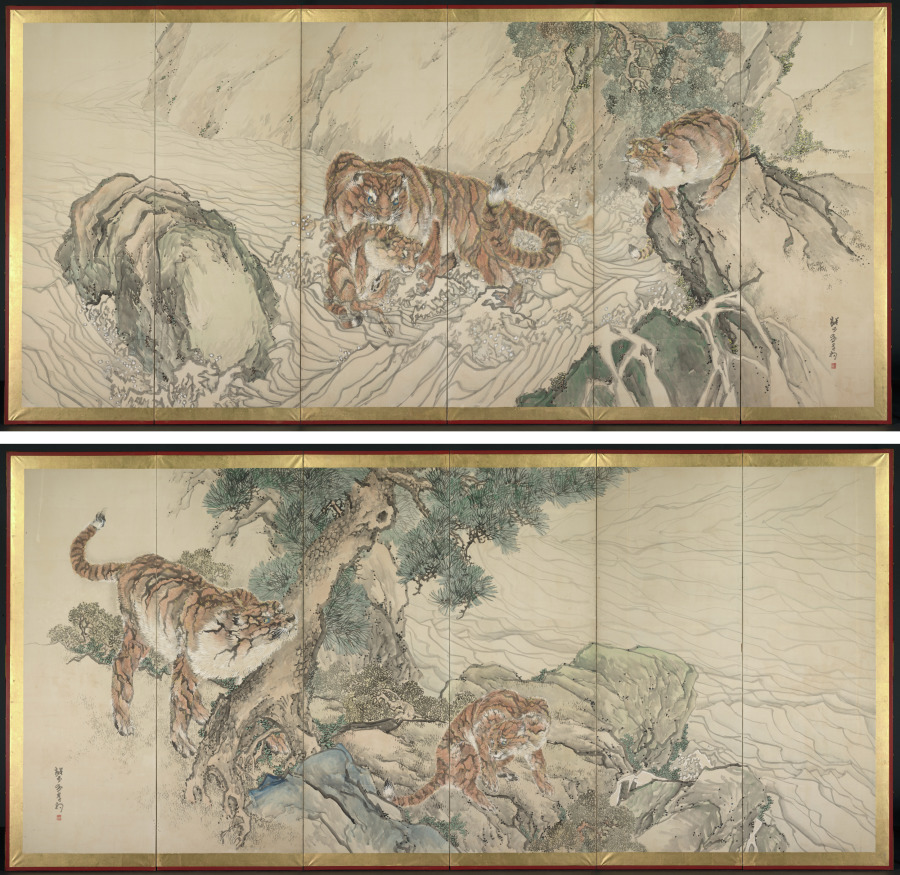
Tiger Family (early 1800s) is in the Cleveland Museum of Art collection. The museum's creator attribution is Kishi Ganku (Japanese, 1749/56–1838).
The work and its context
The museum's open-access catalogue describes the work:
By the time this self-taught painter reached his thirties, his paintings were keenly sought after by Kyoto’s sophisticated patrons, including members of the imperial family. Judging from the surviving works, his supporters delighted in the colorful, auspicious imagery of Chinese historical figures, blossoming plum trees, cranes, peacocks, roosters, and especially tigers. Kishi Ganku was originally from the coastal town of Kanazawa, but relocated to Kyoto to work for the Arisugawa family. His work incorporates stylistic elements from the Kano school, the Maruyama school, and works by the Chinese artist Shen Nanping (1682–1760).
Object facts
- Title: Tiger Family
- Date: early 1800s
- Creator attribution: Kishi Ganku (Japanese, 1749/56–1838)
- Culture: Japan, Edo period (1615–1868)
- Type: Painting
- Technique: Pair of six-panel folding screens; ink and color on paper
- Dimensions: Overall: 179.4 x 384.8 cm (70 5/8 x 151 1/2 in.)
- Collection: ASIAN - Folding screen
- Department: Japanese Art
- Accession number: 1983.3
Collection credit
Leonard C. Hanna Jr. Fund
Further reading listed by the museum
- Turner, Evan H. “Year in Review for 1983.” The Bulletin of the Cleveland Museum of Art 71, no. 2 (February 1984): 38–79.
- Cunningham, Michael R. “Byōbu: The Art of the Japanese Screen.” The Bulletin of the Cleveland Museum of Art 71, no. 7 (September 1984): 223–232.
- Cunningham, Michael R. Unfolding Beauty: Japanese Screens from the Cleveland Museum of Art. Cleveland, OH: Cleveland Museum of Art, 2001.
View the collection record
See the museum's photographs and full catalogue entry. Catalogue text is reproduced from the Cleveland Museum of Art's open-access data, with HTML formatting removed. This object and its supplied image are designated CC0.
Sources
More in Lifestyle
Keep reading