Tigers Chasing Deer, with Dragon (1000s–1200): Art, History and Details
Tigers Chasing Deer, with Dragon at the Cleveland Museum of Art: 1000s–1200, Silk and gold thread; tapestry. Explore the work's context, creator attribution and collection history.
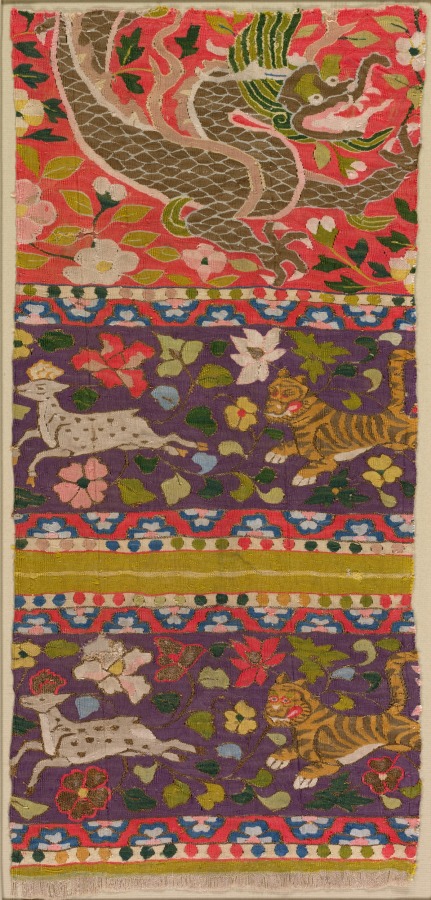
Tigers Chasing Deer, with Dragon (1000s–1200) is in the Cleveland Museum of Art collection.
The work and its context
The museum's open-access catalogue describes the work:
This reversible tapestry (kesi) fragment woven with silk and metal thread is a section from yardage likely intended for a garment, but no contemporary paintings exist to confirm this. The starting, bottom edge of the textile is preserved which indicates the bands at the base would have been the cuff ends of a garment. The design motifs of this kesi—a dragon at the top, bands of pearls and split palmettes, and tigers chasing deer with mushroom-shaped antlers—are a synthesis of Western and Chinese elements. The pearls, palmettes, and deer motifs originated in Iran and Sogdiana (an area east of the Caspian Sea and northwest of the Himalayas) but migrated east to China during the Tang dynasty (618–907). Although these motifs disappeared from Chinese art after the fall of the Tang, they survived in Central Asia. In contrast, the dragon is Chinese in origin, but here has a Central Asian form (particularly its extended snout).
Object facts
- Title: Tigers Chasing Deer, with Dragon
- Date: 1000s–1200
- Culture: China, Eastern, 11th-12th century
- Type: Textile
- Technique: Silk and gold thread; tapestry
- Dimensions: Overall: 58 x 27.2 cm (22 13/16 x 10 11/16 in.); Mounted: 75.6 x 43.8 cm (29 3/4 x 17 1/4 in.)
- Collection: Textiles
- Department: Textiles
- Accession number: 1988.100
A detail from the museum
Two similar kesi in Cleveland’s collection include 1991.3 and 1988.33. All are roughly the same size and given their size all three rectangular fragments may have been used as sutra (prayer leaves) covers. All three have two vertical crease lines that divide the fragment roughly into thirds and differential fading between the central third and outer thirds, which further substantiates this possible usage.
Collection credit
Leonard C. Hanna Jr. Fund
Further reading listed by the museum
- Simcox, Jacqueline. "Silks from the Middle Kingdom." Hali: The International Magazine of Fine Carpets and Textiles, Issue 43, (February 1989).
- “The Year in Review for 1988.” The Bulletin of the Cleveland Museum of Art 76, no. 2 (February 1989): 30–75.
- Wilson, J. Keith. "Powerful Form and Potent Symbol: The Dragon in Asia." The Bulletin of the Cleveland Museum of Art 77, no. 8 (1990).
View the collection record
See the museum's photographs and full catalogue entry. Catalogue text is reproduced from the Cleveland Museum of Art's open-access data, with HTML formatting removed. This object and its supplied image are designated CC0.
Sources
More in Lifestyle
Keep reading