Sleep and Death Cista Handle (400–375 BCE): Art, History and Details
Sleep and Death Cista Handle at the Cleveland Museum of Art: 400–375 BCE, bronze. Explore the work's context, creator attribution and collection history.
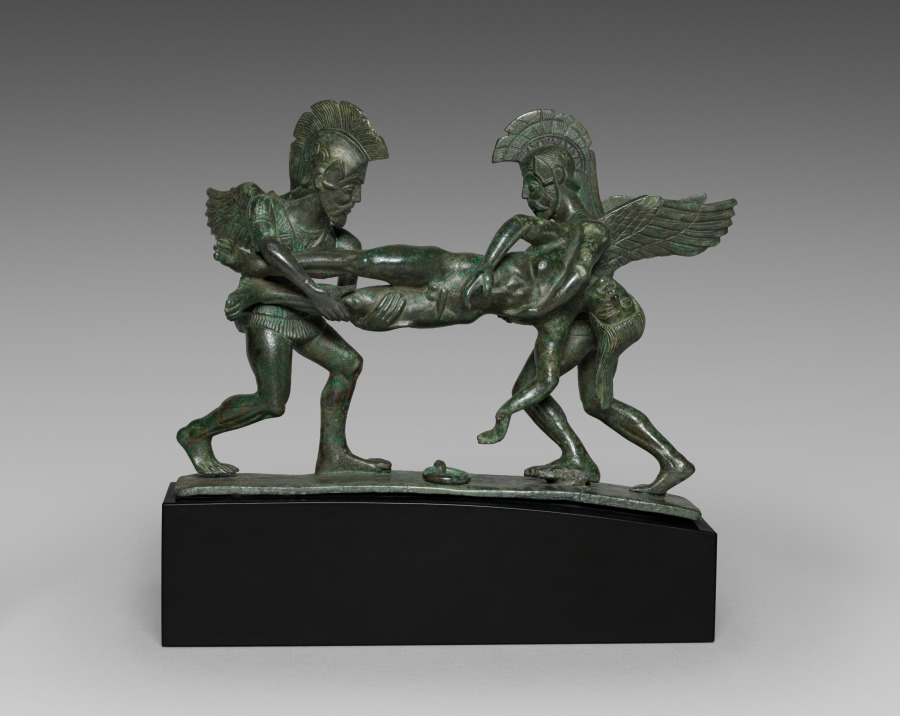
Sleep and Death Cista Handle (400–375 BCE) is in the Cleveland Museum of Art collection.
The work and its context
The museum's open-access catalogue describes the work:
Designed for attachment to the lid of a large bronze cista, a cylindrical lidded box, these three figures probably represent Sleep (Hypnos) and Death (Thanatos) holding the body of Sarpedon. A son of Zeus who helped to defend Troy from invading Greek forces, "godlike Sarpedon of the brazen helmet" fell at the hands of Patroclus, as told by Homer in Book XVI of the Iliad. Apollo then intervened to protect the body, removing it from danger and entrusting it to the two winged deities, as depicted here and in a number of other ancient artworks, Greek and Etruscan alike. If not Sarpedon, the fallen warrior could be Memnon, the son of Eos and Tithonos slain by Achilles.
Object facts
- Title: Sleep and Death Cista Handle
- Date: 400–375 BCE
- Culture: Etruscan
- Type: Sculpture
- Technique: bronze
- Dimensions: with base: 18.5 x 18.3 cm (7 5/16 x 7 3/16 in.); without base: 14 x 17.4 cm (5 1/2 x 6 7/8 in.)
- Collection: GR - Etruscan
- Department: Greek and Roman Art
- Accession number: 1945.13
A detail from the museum
These three figures were cast in eight separate pieces, then welded together and attached to the rectangular base.
Collection credit
Purchase from the J. H. Wade Fund
Further reading listed by the museum
- Castellani, Alessandro, and Paul Leroi. Catalogue des Objets d'Art Antiques du Moyen-âge et de la Renaissance Dépendant de la Succession Alessandro Castellani. [By Paul Leroi]. Paris, 1884.
- British Museum, and H. B. Walters. Catalogue of the Bronzes, Greek, Roman, and Etruscan, in the Department of Greek and Roman Antiquities, British Museum. London: Printed by order of the Trustees, 1899.
- Furtwängler, Adolf. Die Antiken Gemmen; Geschichte der Steinschneidekunst im Klassischen Altertum. Leipzig: Gesecke & Devrient, 1900.
View the collection record
See the museum's photographs and full catalogue entry. Catalogue text is reproduced from the Cleveland Museum of Art's open-access data, with HTML formatting removed. This object and its supplied image are designated CC0.
Sources
More in Lifestyle
Keep reading