Trial Piece Worked on Both Sides (c. 1391–1353 BCE): Art, History and Details
Trial Piece Worked on Both Sides at the Cleveland Museum of Art: c. 1391–1353 BCE, limestone. Explore the work's context, creator attribution and collection history.
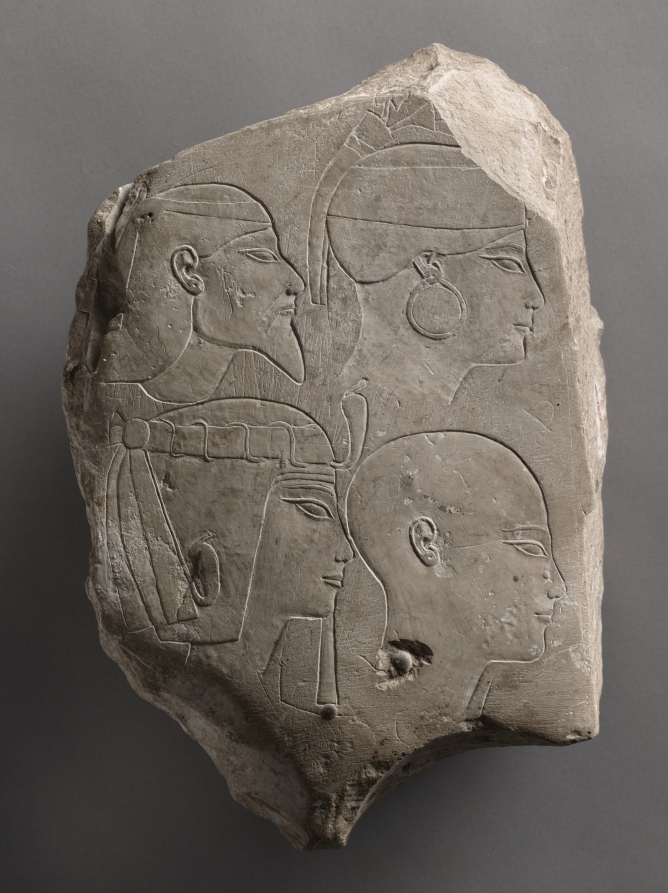
Trial Piece Worked on Both Sides (c. 1391–1353 BCE) is in the Cleveland Museum of Art collection.
The work and its context
The museum's open-access catalogue describes the work:
This carved flake of limestone provides a fascinating glimpse of the ancient artist at work. One side, by far the better, features four studies of heads. At the upper left is an Asiatic. He has a low forehead, a prominent nose, and a long, pointed beard. To his right is a Nubian wearing the short, round headdress and large loop earring that the Egyptians usually identified with this ethnic group. The bottom row presents images from within Egypt. At the left is a stock image of a king. To his right is another Egyptian, whose clean-shaven head immediately identifies him as a priest.
Object facts
- Title: Trial Piece Worked on Both Sides
- Date: c. 1391–1353 BCE
- Culture: Egypt, probably Thebes, New Kingdom (1540–1069 BCE), Dynasty 18, reign of Amenhotep III (1390–1352 BCE)
- Type: Sculpture
- Technique: limestone
- Dimensions: Overall: 34.4 x 24 x 7 cm (13 9/16 x 9 7/16 x 2 3/4 in.)
- Collection: Egypt - New Kingdom
- Department: Egyptian and Ancient Near Eastern Art
- Accession number: 1920.1975.a
A detail from the museum
Trial pieces were a necessity of this busy building period because new styles were continually introduced and rapid training of apprentices was needed.
Collection credit
Gift of the John Huntington Art and Polytechnic Trust
Further reading listed by the museum
- The Cleveland Museum of Art. Handbook of the Cleveland Museum of Art. Cleveland, OH: The Cleveland Museum of Art, 1925.
- The Cleveland Museum of Art. Handbook of the Cleveland Museum of Art. Cleveland, OH: The Cleveland Museum of Art, 1928.
View the collection record
See the museum's photographs and full catalogue entry. Catalogue text is reproduced from the Cleveland Museum of Art's open-access data, with HTML formatting removed. This object and its supplied image are designated CC0.
Sources
More in Lifestyle
Keep reading