Trophy Cup and Cover (1792–1793): Art, History and Details
Trophy Cup and Cover at the Cleveland Museum of Art: 1792–1793, silver gilt. Explore the work's context, creator attribution and collection history.
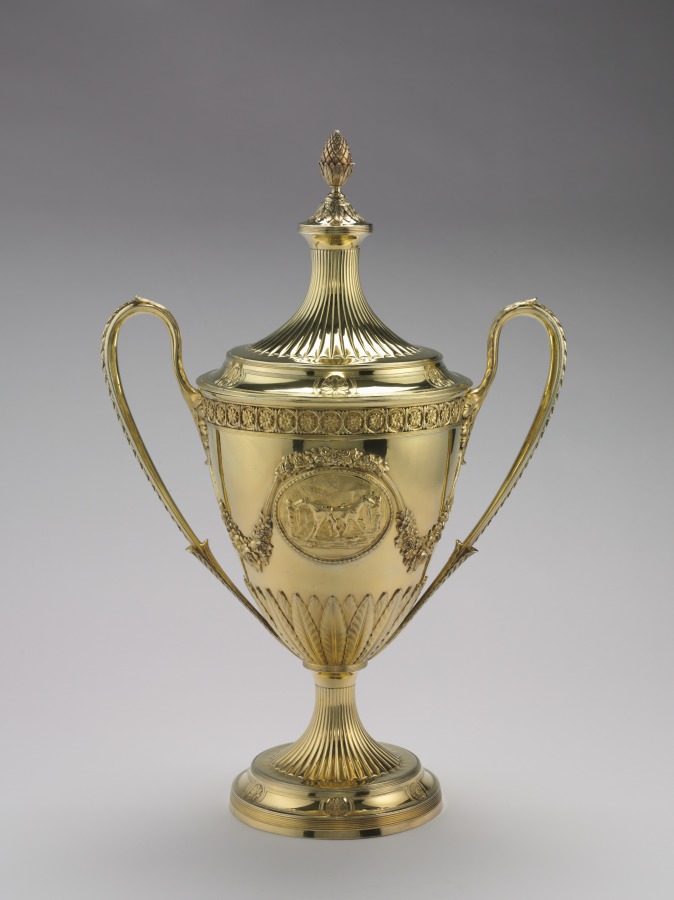
Trophy Cup and Cover (1792–1793) is in the Cleveland Museum of Art collection. The museum's creator attribution is Peter Bateman (British, 1740–1825); Anne Bateman (British, 1748–1813).
The work and its context
The museum's open-access catalogue describes the work:
Silver fulfilled a prominent role in projecting wealth, status, power, and ritual in British life during the 1600s and 1700s. Elaborate forms such as this trophy, with its swags of flowers, neoclassical rosettes, acanthus spears, and acorn finial, not only represented wealth in its sheer silver weight but also provided royal and aristocratic owners a surface for displaying engraved coats of arms. Engraved on one side of this trophy cup can be found the arms of Robert Grosvenor (1767–1845), the first Marquess of Westminster, and Lady Eleanor Egerton (1770–1846), whom he married in 1794, a year after the trophy’s completion. The other side depicts preparations for a horserace, the most culturally significant leisure activity enjoyed by aristocratic families in the 1700s. Grosvenor owned a number of famous horses and was likely awarded this trophy following a successful race.
Object facts
- Title: Trophy Cup and Cover
- Date: 1792–1793
- Creator attribution: Peter Bateman (British, 1740–1825); Anne Bateman (British, 1748–1813)
- Culture: England, 18th century
- Type: Silver
- Technique: silver gilt
- Dimensions: Overall: 59.7 x 40 cm (23 1/2 x 15 3/4 in.)
- Collection: Decorative Arts
- Department: Decorative Art and Design
- Accession number: 1968.30
A detail from the museum
The graceful form of this trophy by Peter Bateman and his sister-in-law Anne Dowling Bateman is reminiscent of the elegant designs produced by their mother Hester Bateman (1708–1794), one of the most celebrated female silversmiths of all time.
Collection credit
Anonymous gift in memory of Margaret Quayle Kerruish; the Thomas S. Grasselli Memorial Collection, and various donors by exchange
View the collection record
See the museum's photographs and full catalogue entry. Catalogue text is reproduced from the Cleveland Museum of Art's open-access data, with HTML formatting removed. This object and its supplied image are designated CC0.
Sources
More in Lifestyle
Keep reading