Tunic (1100–1532): Art, History and Details
Tunic at the Cleveland Museum of Art: 1100–1532, white cotton; plain weave with supplementary weft brocading. Explore the work's context, creator attribution and collection history.
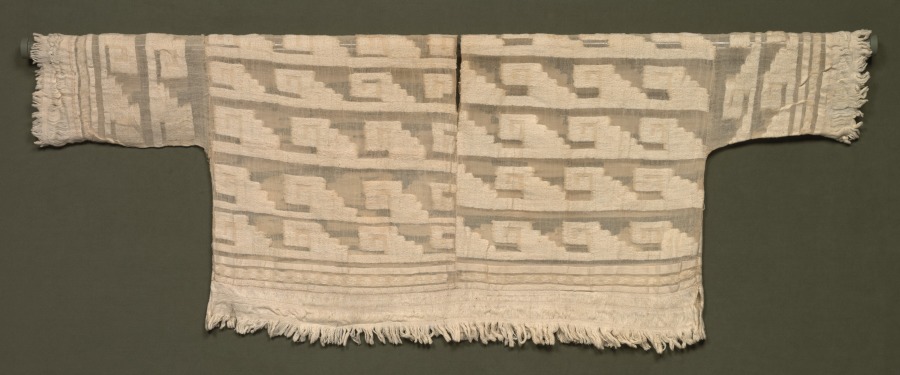
Tunic (1100–1532) is in the Cleveland Museum of Art collection.
The work and its context
The museum's open-access catalogue describes the work:
This garment embodies an important principle of the Chimú textile aesthetic: a love of combining different textures, some dense and sculptural and others so open and airy they are nearly invisible. (The hand-spun yarns are only .1 to .2 millimeters in diameter.) It also elegantly articulates the simplified, spare visual vocabulary that the Chimú favored, here geometric motifs.
Object facts
- Title: Tunic
- Date: 1100–1532
- Culture: Peru, Chimú or Chimú-Inka, 12th-16th century
- Type: Textile
- Technique: white cotton; plain weave with supplementary weft brocading
- Dimensions: Overall: 57.2 x 151.1 cm (22 1/2 x 59 1/2 in.)
- Collection: T - Pre-Columbian
- Department: Textiles
- Accession number: 2011.111.1
A detail from the museum
The Chimú forged an empire that thrived until the 1460s, when the Inka incorporated it into their own imperial domain.
Collection credit
Severance and Greta Millikin Purchase Fund
Further reading listed by the museum
- Cleveland Museum of Art. The CMA Companion: A Guide to the Cleveland Museum of Art. Cleveland: Cleveland Museum of Art, 2014.
- "Permanent Collection Installations.” Cleveland Art: Cleveland Museum of Art Members Magazine 63, no. 3 (2023): 12-13.
View the collection record
See the museum's photographs and full catalogue entry. Catalogue text is reproduced from the Cleveland Museum of Art's open-access data, with HTML formatting removed. This object and its supplied image are designated CC0.
Sources
More in Lifestyle
Keep reading