Turkmen Main Carpet (mid-1850s): Art, History and Details
Turkmen Main Carpet at the Cleveland Museum of Art: mid-1850s, Wool, knotted pile, 128-136 symmetrical knots per square inch. Explore the work's context, creator attribution and collection history.
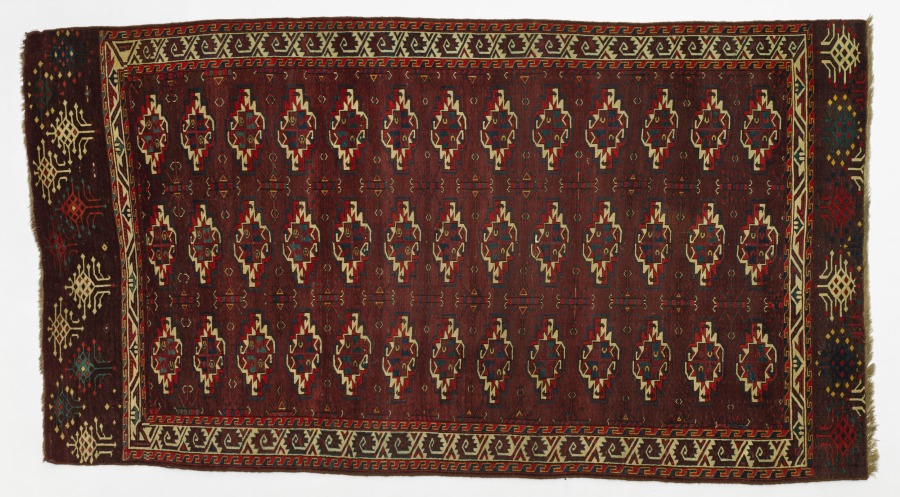
Turkmen Main Carpet (mid-1850s) is in the Cleveland Museum of Art collection.
The work and its context
The museum's open-access catalogue describes the work:
In the Islamic world, carpets symbolize status and wealth. A carpet’s origin can be identified by its design, color, and technique. Shades of red and lobed motifs, or guls, are hallmarks of Turkmen carpets woven by nomadic tribes across northeast Iran, Afghanistan, and central Asia. This main carpet of the Yomud tribe features beautiful colors in the guls on a rich aubergine ground; the decorated skirts, or elem, with stylized flora at each end, are its rarest feature. This carpet would have been the prized possession within the living quarters of a round tent, or yurt.
Object facts
- Title: Turkmen Main Carpet
- Date: mid-1850s
- Culture: Turkmenistan, Yomud tribe, 19th century
- Type: Carpet
- Technique: Wool, knotted pile, 128-136 symmetrical knots per square inch
- Dimensions: Overall: 290 x 160 cm (114 3/16 x 63 in.)
- Collection: Textiles
- Department: Textiles
- Accession number: 2010.190
Collection credit
Gift of E.B. and Joan C. Long
View the collection record
See the museum's photographs and full catalogue entry. Catalogue text is reproduced from the Cleveland Museum of Art's open-access data, with HTML formatting removed. This object and its supplied image are designated CC0.
Sources
More in Lifestyle
Keep reading