Vessel (300s BCE): Art, History and Details
Vessel at the Cleveland Museum of Art: 300s BCE, Earthenware. Explore the work's context, creator attribution and collection history.
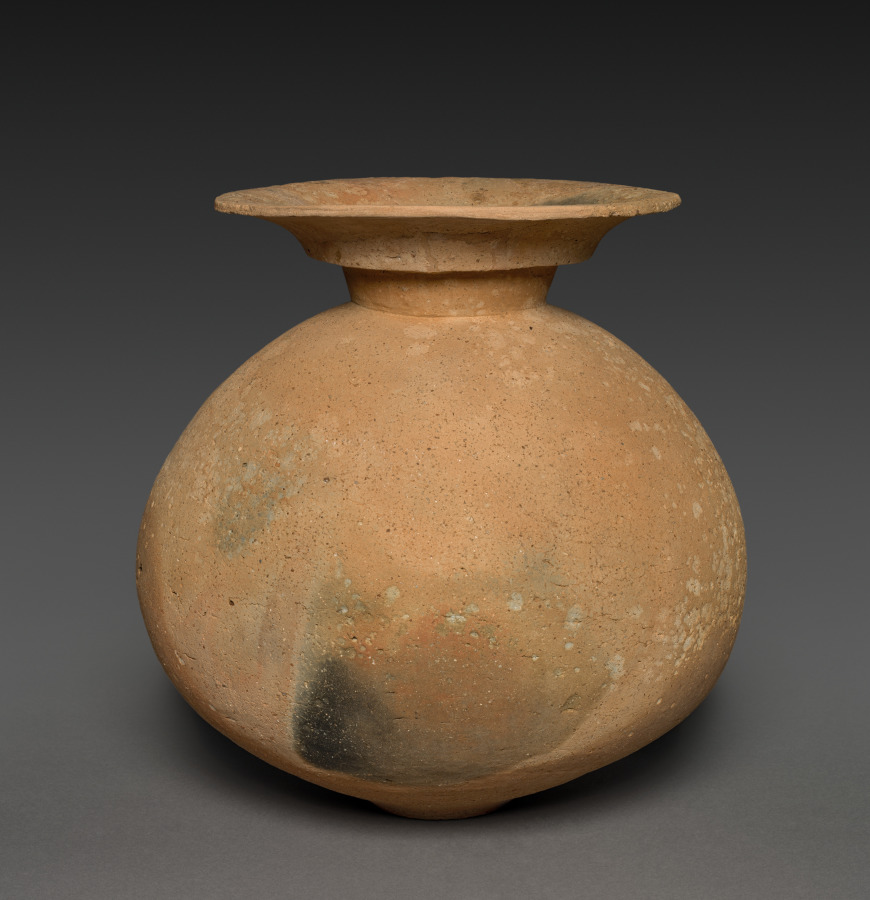
Vessel (300s BCE) is in the Cleveland Museum of Art collection.
The work and its context
The museum's open-access catalogue describes the work:
Pottery existed for thousands of years in Japan before the Yayoi period, but the development of wet rice agriculture and permanent settlements by previously nomadic communities changed its form significantly. Yayoi period pots were aimed more at long-term storage than those from prior millennia. Their smooth, unadorned surfaces and round shapes also reflect the style of contemporaneous works from the Korean peninsula, indicating the strong ties between Japanese communities and Korean kingdoms at the time.
Object facts
- Title: Vessel
- Date: 300s BCE
- Culture: Japan, Yayoi period (c. 300 BCE–300 CE)
- Type: Ceramic
- Technique: Earthenware
- Dimensions: height: 34 cm (13 3/8 in.); Diameter: 33 cm (13 in.)
- Collection: Japanese Art
- Department: Japanese Art
- Accession number: 1989.69
A detail from the museum
Yayoi ceramics, like this example, were likely made by laying one coil of clay on top of another to form the body of the vessel.
Collection credit
Edward L. Whittemore Fund
Further reading listed by the museum
- E. H. T. “The Year in Review: Selections 1989.” The Bulletin of the Cleveland Museum of Art 77, no. 2 (February 1990): 38–78.
- Cunningham, Michael R., "Asian Autumn", Cleveland Museum of Art. Cleveland Art: The Cleveland Museum of Art Members Magazine. Vol. 35 no. 08, October 1995
View the collection record
See the museum's photographs and full catalogue entry. Catalogue text is reproduced from the Cleveland Museum of Art's open-access data, with HTML formatting removed. This object and its supplied image are designated CC0.
Sources
More in Lifestyle
Keep reading
Related stories