Vessel with Oculate Being (300 BCE–1 CE): Art, History and Details
Vessel with Oculate Being at the Cleveland Museum of Art: 300 BCE–1 CE, earthenware with resin-based paint. Explore the work's context, creator attribution and collection history.
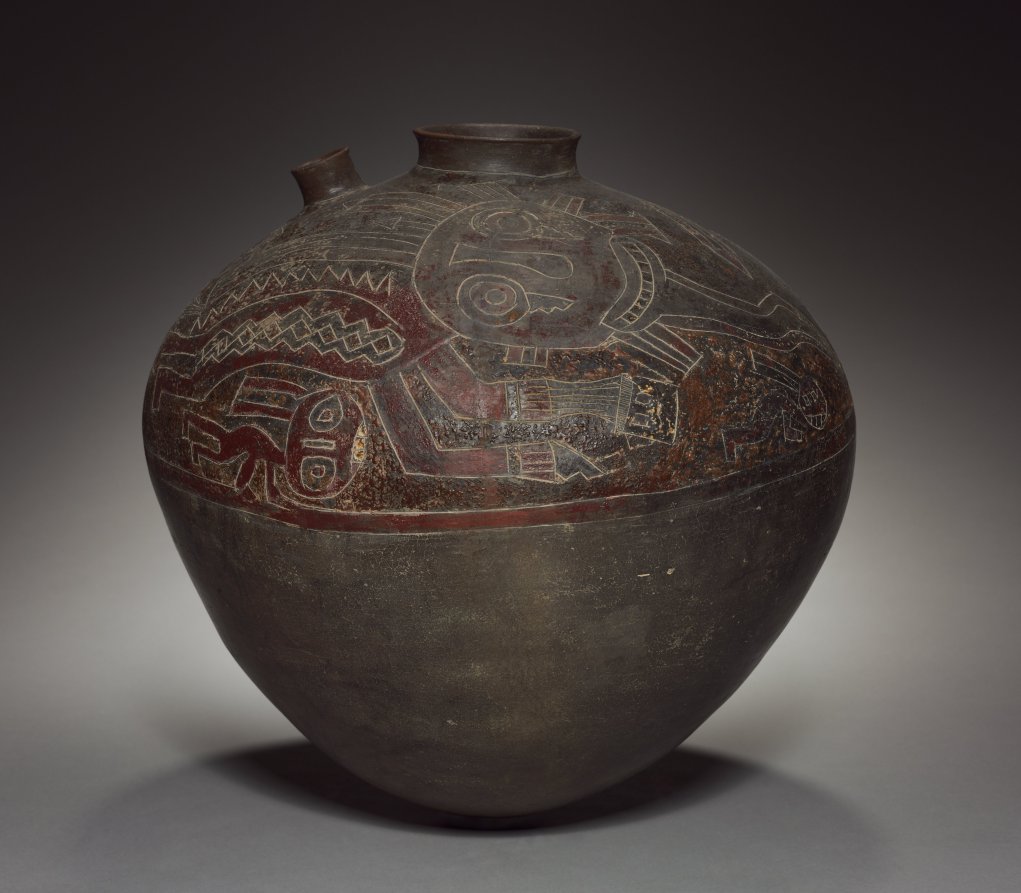
Vessel with Oculate Being (300 BCE–1 CE) is in the Cleveland Museum of Art collection.
The work and its context
The museum's open-access catalogue describes the work:
A supernatural creature known today as the Oculate Being, after its huge eyes, became prominent late in Paracas times. The Paracas left no written records and this creature's meaning is poorly apprehended, but it clutches a severed human head by the hair. A hint of the head's significance comes from the Oculate Being itself, whose head sprouts streamers that may represent abstract energy or force. The severed head cult, then, may have aimed at capturing and redirecting this energy. (Other Paracas objects appear nearby.)
Object facts
- Title: Vessel with Oculate Being
- Date: 300 BCE–1 CE
- Culture: Peru, South Coast, Paracas (Cavernas) style (700 BCE–1 CE)
- Type: Ceramic
- Technique: earthenware with resin-based paint
- Dimensions: Overall: 40.8 cm (16 1/16 in.)
- Collection: AA - Andes
- Department: Art of the Americas
- Accession number: 1998.70
Collection credit
Norman O. Stone and Ella A. Stone Memorial Fund
Further reading listed by the museum
- Bergh, Susan E., "Ancient Eyes", Cleveland Museum of Art. Cleveland Art: The Cleveland Museum of Art Members Magazine. Vol. 44 no. 06, Summer 2004
View the collection record
See the museum's photographs and full catalogue entry. Catalogue text is reproduced from the Cleveland Museum of Art's open-access data, with HTML formatting removed. This object and its supplied image are designated CC0.
Sources
More in Lifestyle
Keep reading