Waist Cloth (Kain Panjeng) (1800s-early 1900s): Art, History and Details
Waist Cloth (Kain Panjeng) at the Cleveland Museum of Art: 1800s-early 1900s, cotton: batik. Explore the work's context, creator attribution and collection history.
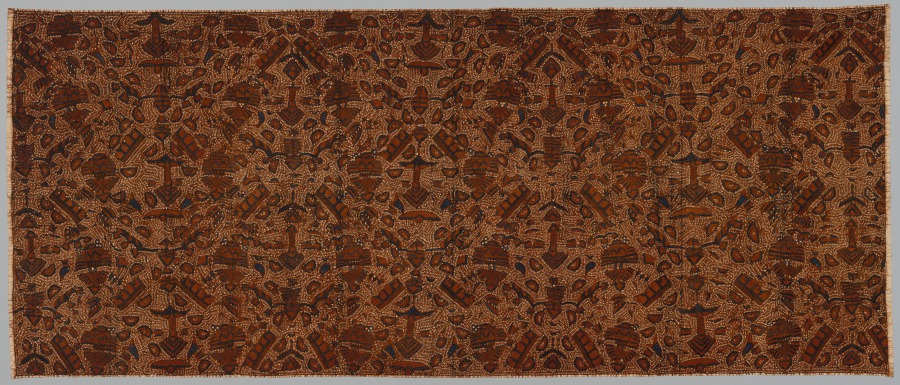
Waist Cloth (Kain Panjeng) (1800s-early 1900s) is in the Cleveland Museum of Art collection.
The work and its context
The museum's open-access catalogue describes the work:
Unlike the Chinese and sometimes European motifs of northern Javanese batiks, the motifs represented on the batiks of central Java are indigenous. However, due to the influence of Islam, they are represented in a very abstract, stylized fashion. In this batik, a celestial scene—probably signifying the ritual renewal of community life and prosperity—is repeated against a background of small filling motifs. The scene consists of a ship (represented as a divided bow and stern) bearing a Tree of Life, which signifies the community's passage to renewed life; on either side of the ship is a winged pavilion; and above is a sacred mountain, the abode of the gods, with a shrine.
Object facts
- Title: Waist Cloth (Kain Panjeng)
- Date: 1800s-early 1900s
- Culture: Indonesia, Central Java, 19th century - early 20th century
- Type: Textile
- Technique: cotton: batik
- Dimensions: Overall: 248.9 x 181.6 cm (98 x 71 1/2 in.)
- Collection: Textiles
- Department: Textiles
- Accession number: 1925.488
Collection credit
Purchase from the J. H. Wade Fund
View the collection record
See the museum's photographs and full catalogue entry. Catalogue text is reproduced from the Cleveland Museum of Art's open-access data, with HTML formatting removed. This object and its supplied image are designated CC0.
Sources
More in Lifestyle
Keep reading