Wall Hanging or Ceiling Canopy (early 1900s): Art, History and Details
Wall Hanging or Ceiling Canopy at the Cleveland Museum of Art: early 1900s, tabby weave, weft ikat; silk. Explore the work's context, creator attribution and collection history.
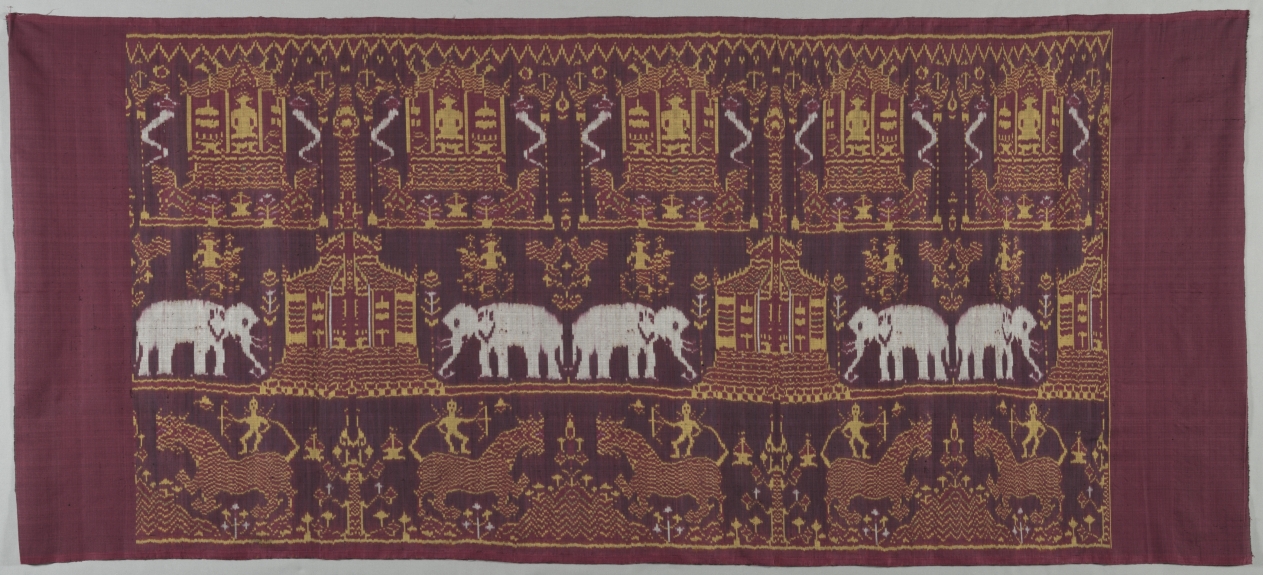
Wall Hanging or Ceiling Canopy (early 1900s) is in the Cleveland Museum of Art collection.
The work and its context
The museum's open-access catalogue describes the work:
The silk wefts of this textile were resist dyed with a design of elephants, temples, large tigers (?), sacred trees, and humans before the textile was woven. Both the weft-ikat technique and the motifs reveal the influence of Indian textiles, particularly patola. The dark reddish-maroon color of the ground, however, was not produced by over-dyeing, as in India and Bali, but by the combination of red wefts with black warps. This silk was made to serve as a wall hanging or ceiling canopy in a Buddhist temple.
Object facts
- Title: Wall Hanging or Ceiling Canopy
- Date: early 1900s
- Culture: Cambodia, Khmer People, early 20th century
- Type: Textile
- Technique: tabby weave, weft ikat; silk
- Dimensions: Overall: 90.2 x 205.7 cm (35 1/2 x 81 in.)
- Collection: Textiles
- Department: Textiles
- Accession number: 1925.118
Collection credit
Purchase from the J. H. Wade Fund
View the collection record
See the museum's photographs and full catalogue entry. Catalogue text is reproduced from the Cleveland Museum of Art's open-access data, with HTML formatting removed. This object and its supplied image are designated CC0.
Sources
More in Lifestyle
Keep reading