Worship of Shiva and Devi (early 1700s): Art, History and Details
Worship of Shiva and Devi at the Cleveland Museum of Art: early 1700s, Gum tempera, ink, and gold on paper. Explore the work's context, creator attribution and collection history.
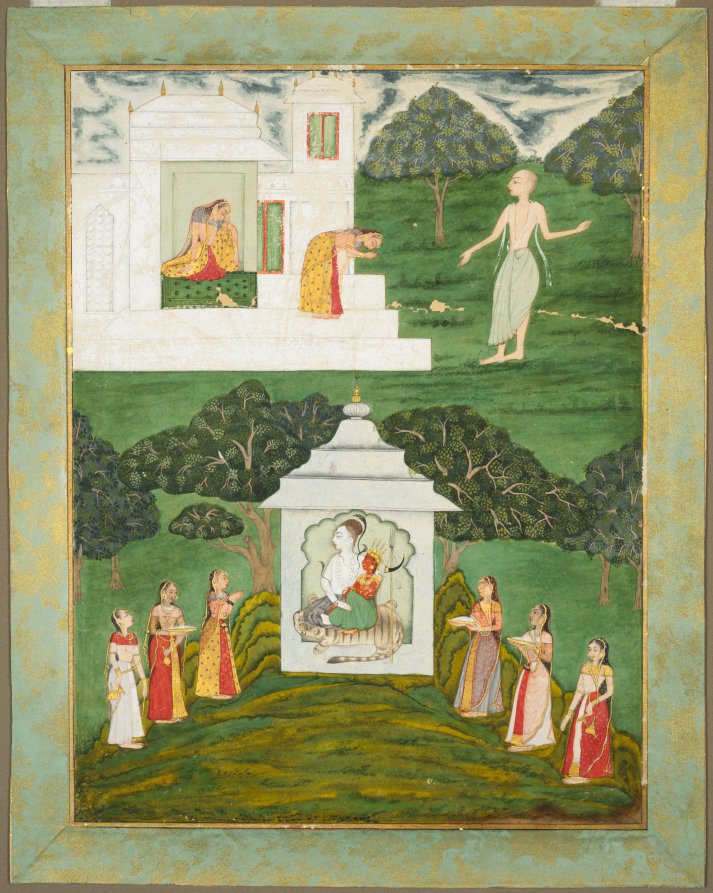
Worship of Shiva and Devi (early 1700s) is in the Cleveland Museum of Art collection.
The work and its context
The museum's open-access catalogue describes the work:
In the shrine in the lower half of the painting, the Hindu god Shiva appears in human form along with his wife, depicted as a red goddess. Shiva has the appearance of a yogi, his matted locs coiled on top of his head, a chain of skulls around his neck. He wears cobras as jewelry, and his body is white with ashes of the cremated dead. The crescent moon perches at his third eye of knowledge. Six women bear offerings in vessels of brass—a pure material suitable for sacred food and drink. The narrative scene featuring a heroine at three moments of time remains unidentified.
Object facts
- Title: Worship of Shiva and Devi
- Date: early 1700s
- Culture: Northwestern India, Rajasthan, Rajput Kingdom of Bikaner
- Type: Painting
- Technique: Gum tempera, ink, and gold on paper
- Dimensions: Image: 26.7 x 20.3 cm (10 1/2 x 8 in.); Overall: 31.2 x 24.5 cm (12 5/16 x 9 5/8 in.)
- Collection: Indian Art
- Department: Indian and Southeast Asian Art
- Accession number: 1967.240
Collection credit
Gift of Dr. and Mrs. Sherman E. Lee
Further reading listed by the museum
- Leach, Linda York. Indian Miniature Paintings and Drawings. Cleveland, OH: Cleveland Museum of Art in cooperation with Indiana University Press, 1986.
View the collection record
See the museum's photographs and full catalogue entry. Catalogue text is reproduced from the Cleveland Museum of Art's open-access data, with HTML formatting removed. This object and its supplied image are designated CC0.
Sources
More in Lifestyle
Keep reading