Yamantaka Vajrabhairava and consort Vajravetali (1700s): Art, History and Details
Yamantaka Vajrabhairava and consort Vajravetali at the Cleveland Museum of Art: 1700s, Silk appliqué embroidery with paper, metallic thread, hair, and ink. Explore the work's context, creator attribution and collection history.
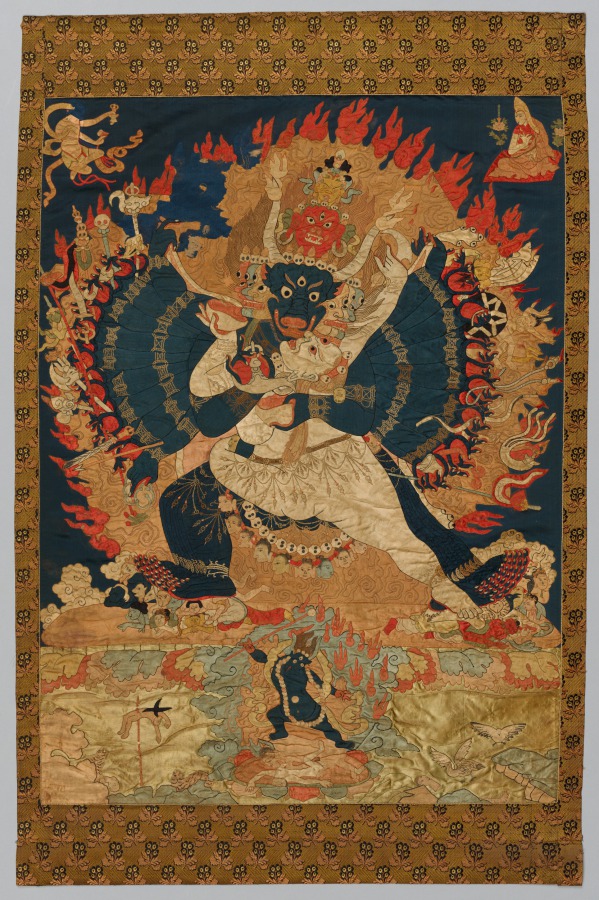
Yamantaka Vajrabhairava and consort Vajravetali (1700s) is in the Cleveland Museum of Art collection.
The work and its context
The museum's open-access catalogue describes the work:
Practitioners of tantric Buddhism meditate on this powerful image to conquer fear of death. As a manifestation of the bodhisattva of wisdom, Manjushri, whose gold head is at the apex of his nine heads, Yamantaka Vajrabhairava demonstrates that wisdom conquers fear and, ultimately, overcomes death itself by leading to enlightenment. With 9 heads, 34 hands, and 16 legs, he surpasses the powers of Yama, god of death. Yama, the blue figure with buffalo head below, has only two arms, and he wields his skull-topped scepter at impaled and decapitated bodies, judging their souls be sent to hell.
Object facts
- Title: Yamantaka Vajrabhairava and consort Vajravetali
- Date: 1700s
- Culture: Tibet
- Type: Embroidery
- Technique: Silk appliqué embroidery with paper, metallic thread, hair, and ink
- Dimensions: Overall: 90.2 x 66 cm (35 1/2 x 26 in.)
- Collection: Textiles
- Department: Textiles
- Accession number: 1918.548
A detail from the museum
His buffalo head connects him with the vehicle ridden by Yama, god of death.
Collection credit
Worcester R. Warner Collection
View the collection record
See the museum's photographs and full catalogue entry. Catalogue text is reproduced from the Cleveland Museum of Art's open-access data, with HTML formatting removed. This object and its supplied image are designated CC0.
Sources
More in Lifestyle
Keep reading