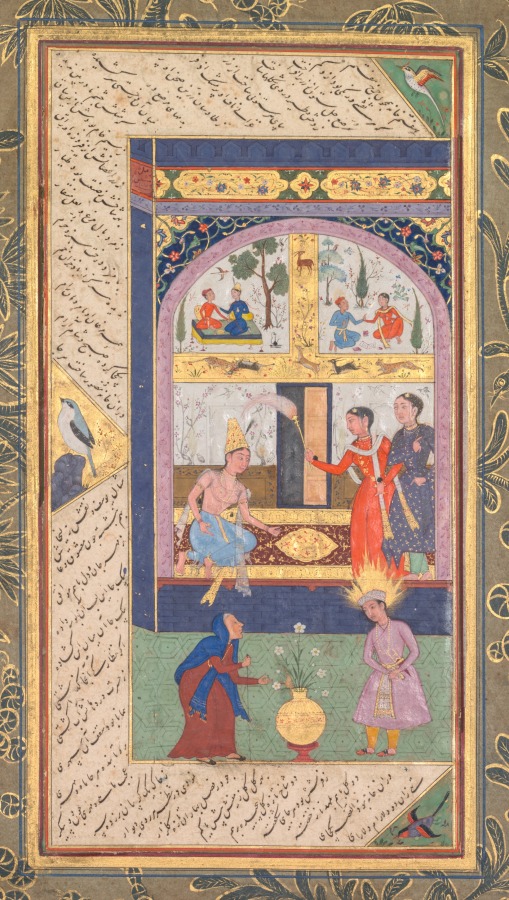
Zulaykha in her palace and as an elderly woman with Joseph (recto), from a Panj Ganj (Five Treasures) of Abd al- Rahman Jami (Persian, 1414–1492) (1603–7): Art, History and Details
Zulaykha in her palace and as an elderly woman with Joseph (recto), from a Panj Ganj (Five Treasures) of Abd al- Rahman Jami (Persian, 1414–1492) at the Cleveland Museum of Art: 1603–7, Gum tempera, ink, and gold on paper. Explore the work'
Zulaykha in her palace and as an elderly woman with Joseph (recto), from a Panj Ganj (Five Treasures) of Abd al- Rahman Jami (Persian, 1414–1492) (1603–7) is in the Cleveland Museum of Art collection. The museum's creator attribution is Mushfiq (Indian, active early 1600s); Sultan 'Ali al-Mashadi (Iranian, 1430–1520).
The work and its context
The museum's open-access catalogue describes the work:
The golden pot of white narcissus flowers at the bottom center of the painting signals that Zulaykha, leaning on her staff to the left, will imminently have her youth and beauty restored. In this Persian retelling of the Old Testament account from the Bible, Zulaykha lusted after Joseph, even though she was already married to Potiphar. Joseph, with the golden halo, resisted her advances until she became a widow and retained his youth, because of his extreme virtue. Above, Zulaykha as a young woman waits for Joseph in her house where murals of them as a happy couple are painted on the walls.
Object facts
- Title: Zulaykha in her palace and as an elderly woman with Joseph (recto), from a Panj Ganj (Five Treasures) of Abd al- Rahman Jami (Persian, 1414–1492)
- Date: 1603–7
- Creator attribution: Mushfiq (Indian, active early 1600s); Sultan 'Ali al-Mashadi (Iranian, 1430–1520)
- Culture: Western Afghanistan, Herat (text); Mughal India (paintings)
- Type: Painting
- Technique: Gum tempera, ink, and gold on paper
- Dimensions: Text area: 17.8 x 9.5 cm (7 x 3 3/4 in.); Page: 31.6 x 20.4 cm (12 7/16 x 8 1/16 in.)
- Collection: Indian Art - Mughal
- Department: Indian and Southeast Asian Art
- Accession number: 2013.315.1.a
A detail from the museum
Zulaykha is shown four times: twice in the murals, seated in the center, and below when she is much older.
Collection credit
Gift in honor of Madeline Neves Clapp; Gift of Mrs. Henry White Cannon by exchange; Bequest of Louise T. Cooper; Leonard C. Hanna Jr. Fund; From the Catherine and Ralph Benkaim Collection
Further reading listed by the museum
- Mace, Sonya Rhie. Mughal Paintings: Art and Stories: The Cleveland Museum of Art. London: D. Giles Limited, 2016.
View the collection record
See the museum's photographs and full catalogue entry. Catalogue text is reproduced from the Cleveland Museum of Art's open-access data, with HTML formatting removed. This object and its supplied image are designated CC0.
Sources
More in Lifestyle
Keep reading
Related stories