Aquamanile: Saddled Horse (c. 1250–1300): Art, History and Details
Aquamanile: Saddled Horse at the Cleveland Museum of Art: c. 1250–1300, copper alloy. Explore the work's context, creator attribution and collection history.
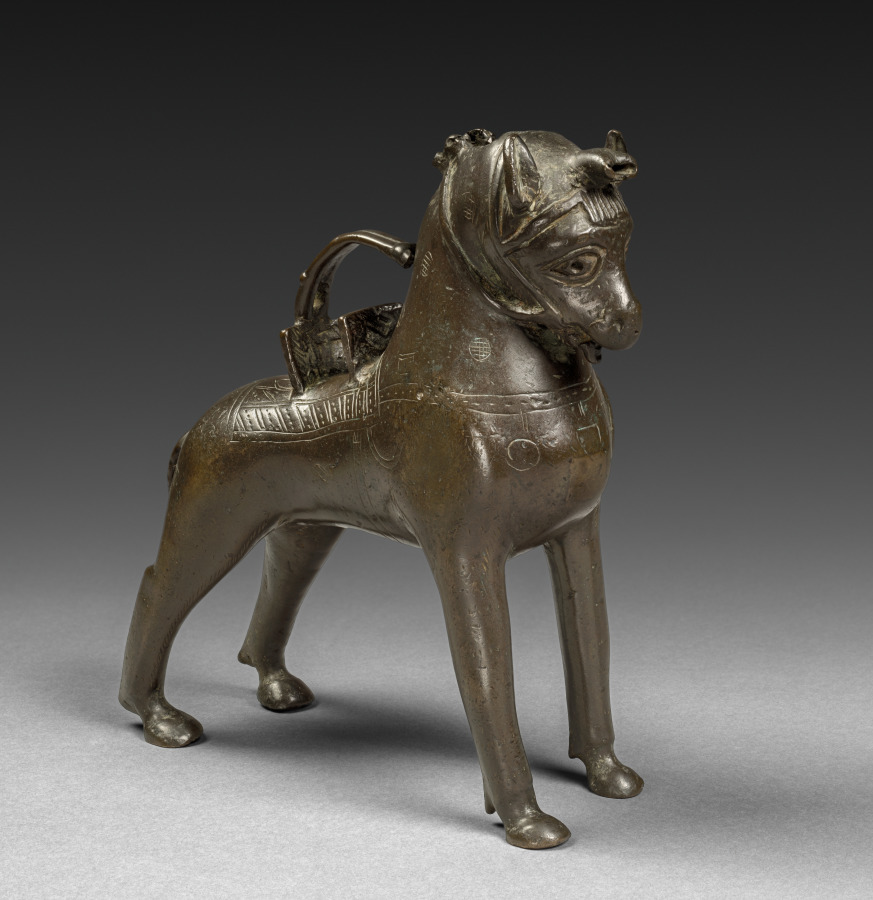
Aquamanile: Saddled Horse (c. 1250–1300) is in the Cleveland Museum of Art collection.
The work and its context
The museum's open-access catalogue describes the work:
Aquamanilia, from the Latin aqua meaning water and manus meaning hands, were hollow cast vessels used for hand washing. Although originally intended for liturgical use they became a common sight in the homes of the nobility in the 1200s and 1300s. Often filled with scented water, these vessels were used to wash hands just before and after eating a meal. An accompanying catch basin would have caught the water as it was being poured. Here we see a proud and alert dappled gray warhorse, highly prized in the medieval period. The saddled but riderless form is rare; other popular aquamanilia include lions, dragons, griffins, and human heads.
Object facts
- Title: Aquamanile: Saddled Horse
- Date: c. 1250–1300
- Culture: North Germany, Lower Saxony (?), 14th century
- Type: Sculpture
- Technique: copper alloy
- Dimensions: Overall: 23.1 x 22.4 cm (9 1/8 x 8 13/16 in.)
- Collection: MED - Gothic
- Department: Medieval Art
- Accession number: 1969.26
A detail from the museum
The pattern of crosshatched circles on the surface suggests that the horse is a dappled gray warhorse, a prized possession in the period.
Collection credit
Purchase from the J. H. Wade Fund
Further reading listed by the museum
- Parke-Bernet Galleries. Italian Maiolica & Works of Art. New York: The Galleries, 1968.
- Lee, Sherman E. “The Year in Review for 1969.” The Bulletin of the Cleveland Museum of Art 57, no. 1 (January 1970): 2–50.
- Wixom, William D. "A Lion Aquamanile" The Bulletin of the Cleveland Museum of Art. Cleveland, Ohio: Cleveland Museum of Art, Vol. 61, No. 8 (October 1974).
View the collection record
See the museum's photographs and full catalogue entry. Catalogue text is reproduced from the Cleveland Museum of Art's open-access data, with HTML formatting removed. This object and its supplied image are designated CC0.
Sources
More in Lifestyle
Keep reading
Related stories