Bodhisattva Vajrapani (700s): Art, History and Details
Bodhisattva Vajrapani at the Cleveland Museum of Art: 700s, copper with traces of gilt. Explore the work's context, creator attribution and collection history.
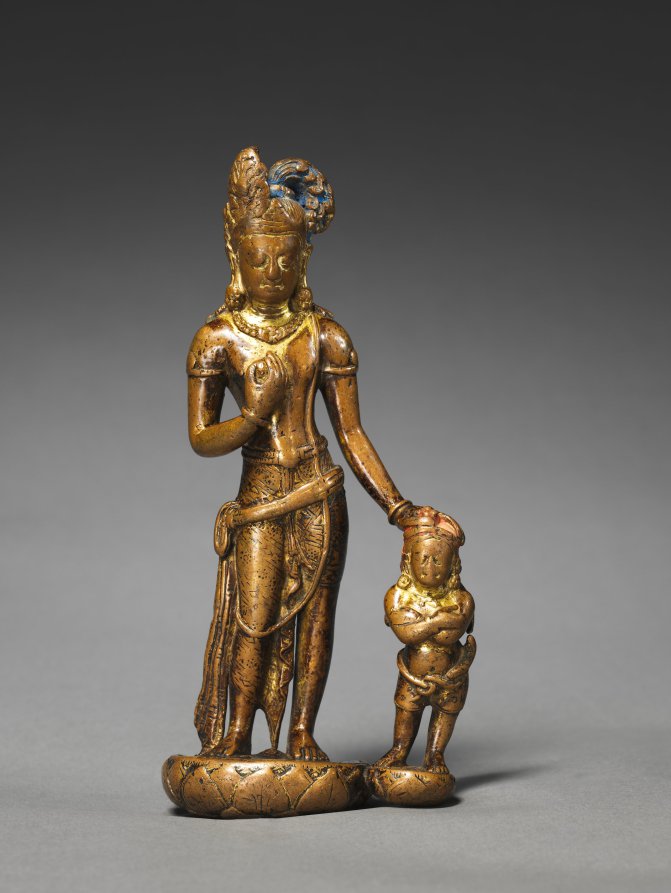
Bodhisattva Vajrapani (700s) is in the Cleveland Museum of Art collection.
The work and its context
The museum's open-access catalogue describes the work:
One of the earliest surviving tantric sculptures, this figure of Vajrapani—"he who holds the lightning bolt"—places his hand on a vajra, a thunder bolt symbol that refers to the lightning speed with which practitioners may achieve enlightenment when they follow tantric techniques. The prongs of the lightning bolt are in his hair; his arms are crossed, and a knotted snake is slung around his hips. Vajrapani's elaborate hairstyle, along with the gentle articulation of the cloth, subtly swaying postures, and introspective expressions are close derivations from 5th-century models, thereby implying an early date for the bronze.
Object facts
- Title: Bodhisattva Vajrapani
- Date: 700s
- Culture: Nepal
- Type: Sculpture
- Technique: copper with traces of gilt
- Dimensions: Overall: 17.8 cm (7 in.)
- Collection: Nepalese Art
- Department: Indian and Southeast Asian Art
- Accession number: 1982.52
Collection credit
John L. Severance Fund
Further reading listed by the museum
- Lee, Sherman E. “Year in Review for 1982.” The Bulletin of the Cleveland Museum of Art 70, no. 1 (1983): 3–55.
- Reedy, Chandra L. Himalayan Bronzes: Technology, Style, and Choices. Newark: University of Delaware Press, 1997.
View the collection record
See the museum's photographs and full catalogue entry. Catalogue text is reproduced from the Cleveland Museum of Art's open-access data, with HTML formatting removed. This object and its supplied image are designated CC0.
Sources
More in Lifestyle
Keep reading