Curtain or bedcover (early 1800s): Art, History and Details
Curtain or bedcover at the Cleveland Museum of Art: early 1800s, plain weave: cotton; embroidery: silk. Explore the work's context, creator attribution and collection history.
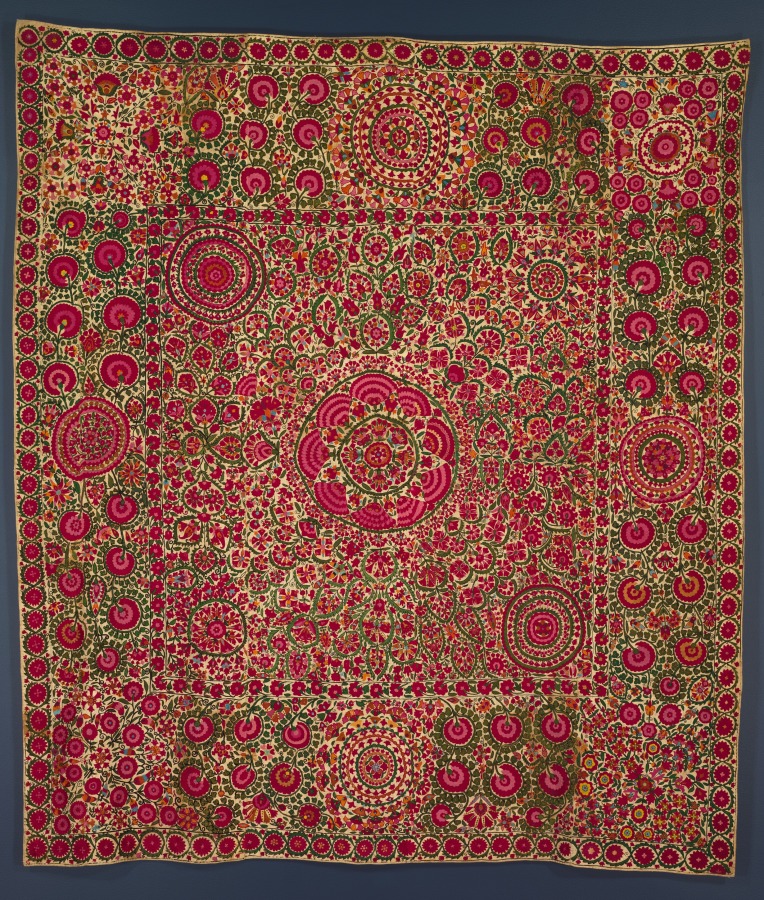
Curtain or bedcover (early 1800s) is in the Cleveland Museum of Art collection.
The work and its context
The museum's open-access catalogue describes the work:
Known as suzani, embroideries with elaborate floral decoration from Central Asia were a significant part of a bride’s dowry and were ceremoniously displayed on special occasions. Women embroidered suzani, mothers passing their skills on to their daughters. Floral and foliate motifs generally dominate, emboldened with several shades of red and multiple borders, perhaps conveying cosmological, medicinal, or fertility associations. However, few display a more bountiful blossoming garden than seen here. Flora radiates from the central fanlike bouquet, a design echoed in the corners of the field and in the wide border, characteristic of work from Bukhara, Uzbekistan. Patterns were drawn on several loosely joined cotton cloths and then embroidered in chain stitch.
Object facts
- Title: Curtain or bedcover
- Date: early 1800s
- Culture: Tajikistan, Ura Tube
- Type: Embroidery
- Technique: plain weave: cotton; embroidery: silk
- Dimensions: Average: 216.5 x 188.6 cm (85 1/4 x 74 1/4 in.)
- Collection: T - Islamic
- Department: Textiles
- Accession number: 1916.1311
Collection credit
Gift of Mr. and Mrs. J. H. Wade
Further reading listed by the museum
- Mackie, Louise W. Symbols of Power: Luxury Textiles from Islamic Lands, 7th-21st Century. Cleveland, OH; New Haven, CT: The Cleveland Museum of Art; Yale University Press, 2015.
View the collection record
See the museum's photographs and full catalogue entry. Catalogue text is reproduced from the Cleveland Museum of Art's open-access data, with HTML formatting removed. This object and its supplied image are designated CC0.
Sources
More in Lifestyle
Keep reading