Embroidered Stola (1700s): Art, History and Details
Embroidered Stola at the Cleveland Museum of Art: 1700s, silk and metal on satin: embroidery. Explore the work's context, creator attribution and collection history.
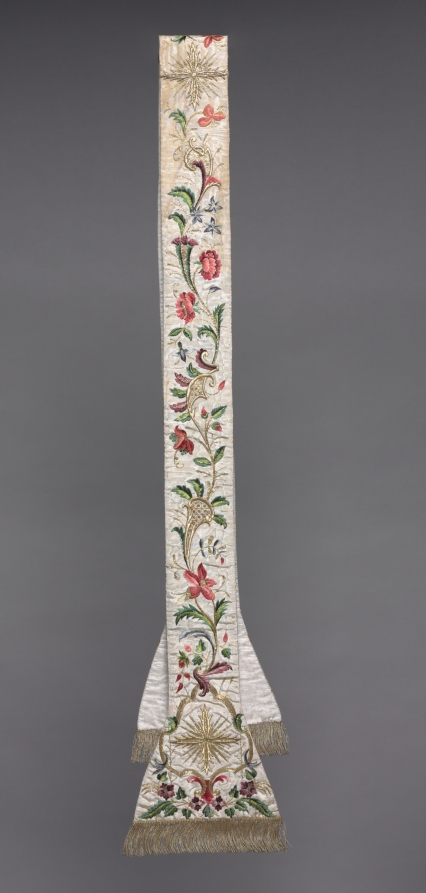
Embroidered Stola (1700s) is in the Cleveland Museum of Art collection.
The work and its context
The museum's open-access catalogue describes the work:
A beautiful design emanates from a vase in the center, displaying symmetrical flora that extend across embroidered gold braids into graceful curvilinear cartouches, reflecting contemporary architectural decoration. Also in the center, sheaves of wheat and grapes represent the bread and wine of the Mass. Gold sequins within thread-outlined squares illustrate fine quality workmanship. The decoration of the stole and chalice veil is similar to the chasuble, also on moiré (watered) silk fabric. The stole, an insignia of the office of deacons and priests, is worn under a chasuble, and the chalice veil—bearing the monogram of Jesus Christ, IHS, in the center—covers the chalice and paten (the plate holding the Eucharistic bread).
Object facts
- Title: Embroidered Stola
- Date: 1700s
- Culture: Italy or Spain
- Type: Embroidery
- Technique: silk and metal on satin: embroidery
- Dimensions: Overall: 254 x 21.6 cm (100 x 8 1/2 in.)
- Collection: T - Ecclesiastical
- Department: Textiles
- Accession number: 1916.1432
Collection credit
Gift of Mr. and Mrs. J. H. Wade
View the collection record
See the museum's photographs and full catalogue entry. Catalogue text is reproduced from the Cleveland Museum of Art's open-access data, with HTML formatting removed. This object and its supplied image are designated CC0.
Sources
More in Lifestyle
Keep reading