Funerary Urn (Hunping) (late 200s CE): Art, History and Details
Funerary Urn (Hunping) at the Cleveland Museum of Art: late 200s CE, green-glazed stoneware with molded and sculpted decoration. Explore the work's context, creator attribution and collection history.
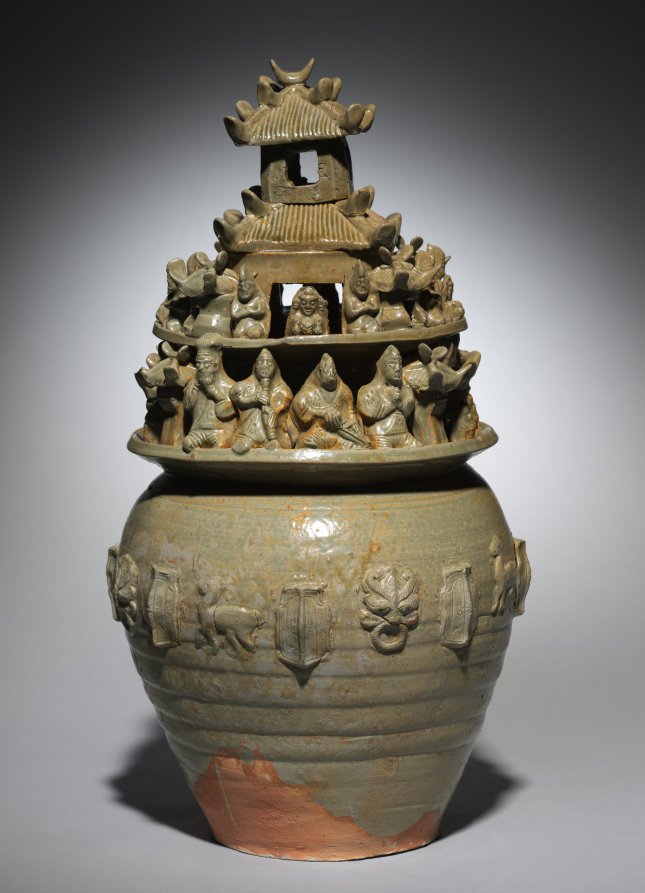
Funerary Urn (Hunping) (late 200s CE) is in the Cleveland Museum of Art collection.
The work and its context
The museum's open-access catalogue describes the work:
Green-glazed stoneware developed greater variety in the south after the Han dynasty. Large funerary urns known as hunping, or "the urn of the soul," are evidence for its prolific production. This type of urn features multistoried towers populated by human figures, animals, and birds. It was likely associated with the southern funerary tradition of "summons of the soul." The wandering soul of the deceased was summoned to return. The urn with architectural designs (sometimes with grains placed inside) provided a safe place of refuge.
Object facts
- Title: Funerary Urn (Hunping)
- Date: late 200s CE
- Culture: China, Western Jin dynasty (265–316 CE)
- Type: Ceramic
- Technique: green-glazed stoneware with molded and sculpted decoration
- Dimensions: Diameter: 28.8 cm (11 5/16 in.); Overall: 52.1 cm (20 1/2 in.)
- Collection: China - Southern Dynasties
- Department: Chinese Art
- Accession number: 1988.21
Collection credit
Severance and Greta Millikin Purchase Fund
Further reading listed by the museum
- “The Year in Review for 1988.” The Bulletin of the Cleveland Museum of Art 76, no. 2 (February 1989): 30–75.
View the collection record
See the museum's photographs and full catalogue entry. Catalogue text is reproduced from the Cleveland Museum of Art's open-access data, with HTML formatting removed. This object and its supplied image are designated CC0.
Sources
More in Lifestyle
Keep reading