Paulownias and Chrysanthemums (early 1800s): Art, History and Details
Paulownias and Chrysanthemums at the Cleveland Museum of Art: early 1800s, Two-panel folding screen; ink and color on gilded paper. Explore the work's context, creator attribution and collection history.
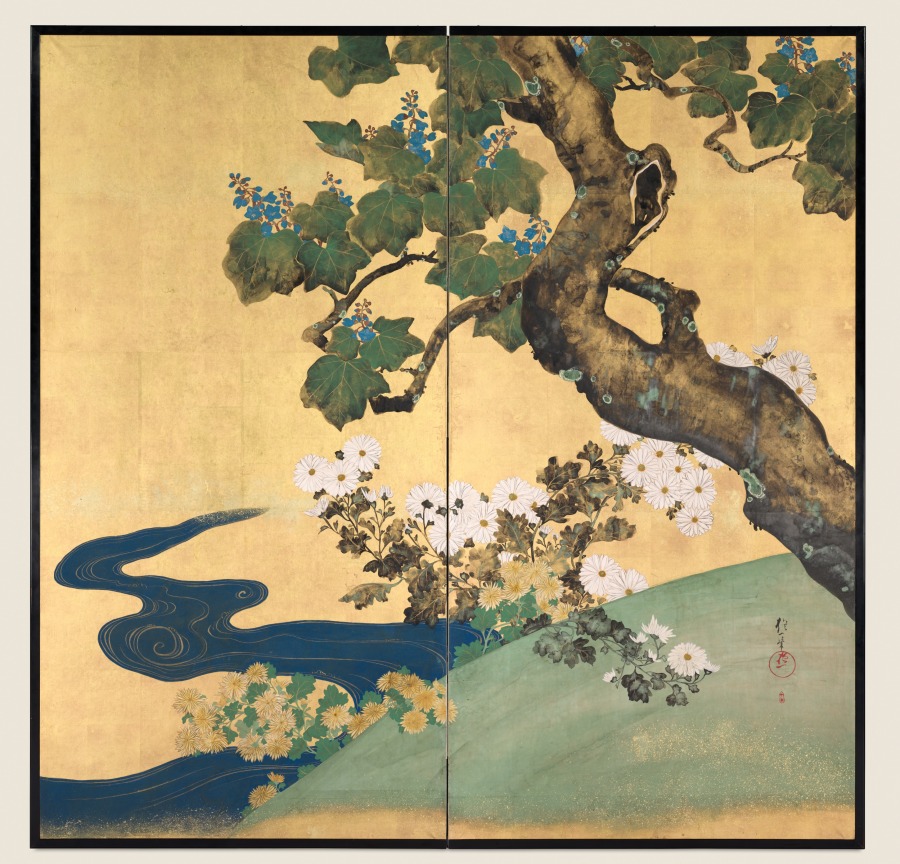
Paulownias and Chrysanthemums (early 1800s) is in the Cleveland Museum of Art collection. The museum's creator attribution is Sakai Hōitsu (Japanese, 1761–1828).
The work and its context
The museum's open-access catalogue describes the work:
In this screen, Sakai Hōitsu expertly deployed a painting technique called “dripping-in” (tarashikomi). Ink and color dripped on the surface, and allowed to pool there, created the illusionistic effect of lichen-dotted tree bark and twisted chrysanthemum leaves. Paulownia and chrysanthemum are signifiers of late spring and early autumn as well as emblems of the Japanese imperial house. Paulownia also has medicinal properties and associations with fortitude, while chrysanthemum symbolizes good government.
Object facts
- Title: Paulownias and Chrysanthemums
- Date: early 1800s
- Creator attribution: Sakai Hōitsu (Japanese, 1761–1828)
- Culture: Japan, Edo period (1615–1868)
- Type: Painting
- Technique: Two-panel folding screen; ink and color on gilded paper
- Dimensions: Image: 152.7 x 154.9 cm (60 1/8 x 61 in.); Overall: 157.5 x 158.5 cm (62 x 62 3/8 in.)
- Collection: ASIAN - Folding screen
- Department: Japanese Art
- Accession number: 1964.386
A detail from the museum
Hōitsu often painted two-panel folding screens for urban clients residing in smaller spaces. A painting after this one in the Itabashi Museum in Tokyo shows an extended composition across a pair of two-panel screens.
Collection credit
Gift of the American Foundation for the Maud E. and Warren H. Corning Botanical Collection
Further reading listed by the museum
- The Cleveland Museum of Art. Handbook of the Cleveland Museum of Art/1966. Cleveland, OH: The Cleveland Museum of Art, 1966.
- The Cleveland Museum of Art. Handbook of the Cleveland Museum of Art/1969. Cleveland, OH: The Cleveland Museum of Art, 1969.
- The Cleveland Museum of Art. Handbook of the Cleveland Museum of Art/1978. Cleveland, OH: The Cleveland Museum of Art, 1978.
View the collection record
See the museum's photographs and full catalogue entry. Catalogue text is reproduced from the Cleveland Museum of Art's open-access data, with HTML formatting removed. This object and its supplied image are designated CC0.
Sources
More in Lifestyle
Keep reading