Globular Pot (25–50 CE): Art, History and Details
Globular Pot at the Cleveland Museum of Art: 25–50 CE, gray ware with black burnished slip and Barbotine decoration. Explore the work's context, creator attribution and collection history.
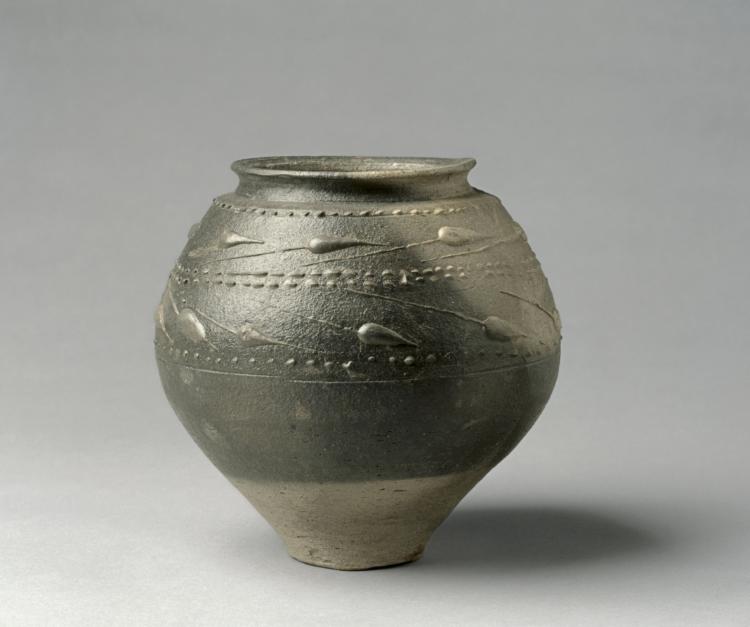
Globular Pot (25–50 CE) is in the Cleveland Museum of Art collection.
The work and its context
The museum's open-access catalogue describes the work:
This pot is decorated with a pattern of leaves arranged in two rows, separated by parallel lines of dots. The vessel was thrown on a potter’s wheel and covered in a dark slip, leaving about two inches above the foot bare. After the Romans occupied Gaul (modern day France and Belgium) in the 1st century BCE, pots like this one with dark brown or black slips became increasingly popular in the northern provinces of the Roman Empire.
Object facts
- Title: Globular Pot
- Date: 25–50 CE
- Culture: Rhenish (Cologne), Gallo-Roman, 2nd quarter 1st Century
- Type: Ceramic
- Technique: gray ware with black burnished slip and Barbotine decoration
- Dimensions: Diameter: 21 cm (8 1/4 in.); Overall: 20.5 cm (8 1/16 in.)
- Collection: GR - Roman
- Department: Greek and Roman Art
- Accession number: 1992.124
A detail from the museum
This pot’s decoration was applied using the barbotine method, in which a reed or horn is used to pipe clay slip onto the surface.
Collection credit
John L. Severance Fund
Further reading listed by the museum
- Turner, Evan H. "The Year in Review for 1992." The Bulletin of the Cleveland Museum of Art 80, no. 2 (1993): 38-79.
View the collection record
See the museum's photographs and full catalogue entry. Catalogue text is reproduced from the Cleveland Museum of Art's open-access data, with HTML formatting removed. This object and its supplied image are designated CC0.
Sources
More in Lifestyle
Keep reading