Jina (Tirthankara) (900s–1000s): Art, History and Details
Jina (Tirthankara) at the Cleveland Museum of Art: 900s–1000s, bronze with silver inlay. Explore the work's context, creator attribution and collection history.
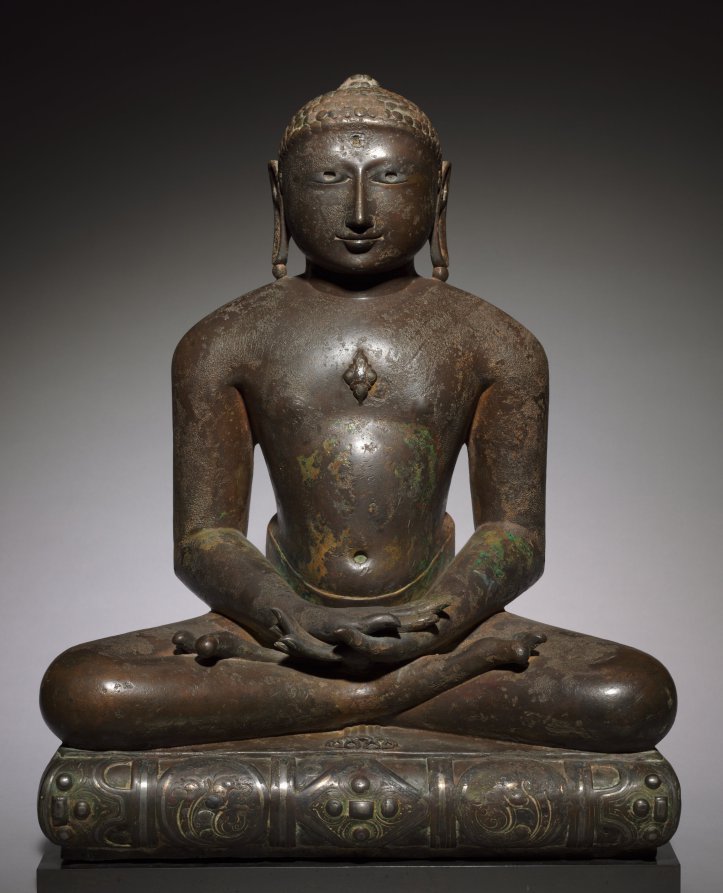
Jina (Tirthankara) (900s–1000s) is in the Cleveland Museum of Art collection.
The work and its context
The museum's open-access catalogue describes the work:
Jainism was one of the three major religions to evolve in India, the other two being Hinduism and Buddhism. While each religion developed its own particular characteristics, their beliefs maintained a common ground with Hinduism. In both Jainism and Buddhism, deities symbolize enlightened beings whose example is meant to inspire believers in following the path toward salvation rather than worshipping them. In Jainism the most common deities are Jinas (meaning "liberators" or "victors"), also known as Tirthankaras ("holy men"). As the name implies, they are beings "liberated" through enlightenment from the cycle of rebirth. There are 24 of these Jain patriarchs. This sculpture represents one of the 24 Jinas, but the absence of attributes makes it impossible to determine which one. This is not surprising since Jinas tend to look alike. Although this figure wears a cloth around his waist, Jinas are usually shown naked—a reference to their renunciation of worldly goods—and seated cross-legged in the posture of meditation (dhyanasana) with their hands resting in their laps (in the dhyana mudra), palms turned upward. Their physical appearance is always the same: broad shoulders, tapering torso, and long, highly stylized limbs. The head, with its round face and short-cropped curls, has a small protrusion at the top. The facial expression conveys self-assurance, wisdom, and compassion. Such a figure would usually have a halo attached to the back of the head. The present bronze dates to a time when some of the finest Jain sculptures and monuments were produced in India, as documented by such temples as Mt. Abu in Rajasthan (the area where this sculpture originated), Khajuraho in Madhya Pradesh, or Srivana Belgola in Karnataka.
Object facts
- Title: Jina (Tirthankara)
- Date: 900s–1000s
- Culture: India, Rajasthan, Medieval period
- Type: Sculpture
- Technique: bronze with silver inlay
- Dimensions: Overall: 61.5 x 49.5 x 36.8 cm (24 3/16 x 19 1/2 x 14 1/2 in.)
- Collection: Indian Art
- Department: Indian and Southeast Asian Art
- Accession number: 2001.88
Collection credit
Severance and Greta Millikin Purchase Fund
Further reading listed by the museum
- Frederick Schultz in Association with Peter Marks Gallery Presents the Jina Collection: March 20-April 28, 2001. New York, N.Y.: Frederick Schultz, 2001.
- Cleveland Museum of Art, “Gift of Major New Stella Sculpture, Purchases of 6th-Century Jeweled Buckle, Ancient Indian Bronze, Ancient Mexican Stone Head Among CMA’s Autumn Acquisitions,” December 26, 2001, Cleveland Museum of Art Archives.
- Czuma, Stanislaw J., "A Classic Jain Bronze", Cleveland Museum of Art. Cleveland Art: The Cleveland Museum of Art Members Magazine. Vol. 42 no. 04, April 2002
View the collection record
See the museum's photographs and full catalogue entry. Catalogue text is reproduced from the Cleveland Museum of Art's open-access data, with HTML formatting removed. This object and its supplied image are designated CC0.
Sources
More in Lifestyle
Keep reading