Priest's Red Cope, Orphrey and Hood (late 1500s - early 1600s): Art, History and Details
Priest's Red Cope, Orphrey and Hood at the Cleveland Museum of Art: late 1500s - early 1600s, Cope: damask weave, silk; Orphrey and hood: brocade, silk and silver. Explore the work's context, creator attribution and collection history.
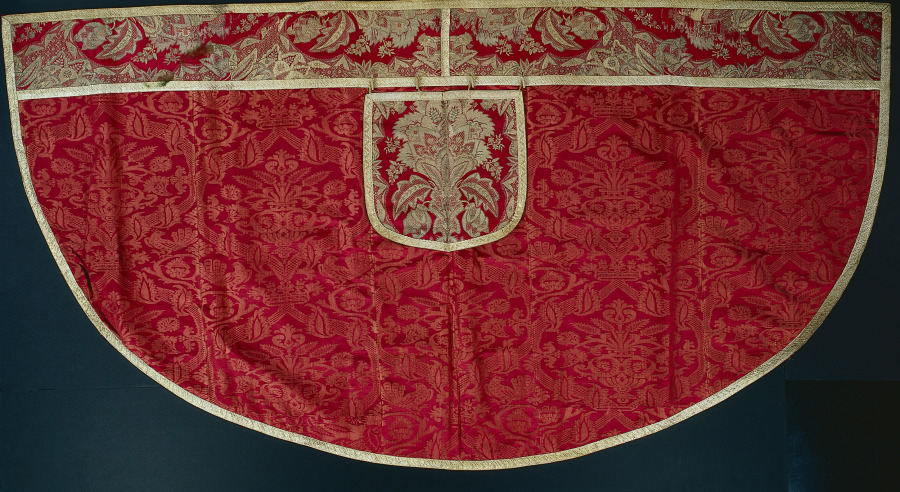
Priest's Red Cope, Orphrey and Hood (late 1500s - early 1600s) is in the Cleveland Museum of Art collection.
The work and its context
The museum's open-access catalogue describes the work:
Liturgical copes are used for processions especially by those who assist the celebrant. They evolved from a secular outer garment with a hood to protect the wearer from wind and rain. Hoods remained although they became decorative and nonfunctional. This Italian silk damask features large symmetrical bouquets in urns within curved lattices bearing crowns flanked by birds. The French orphrey band, or ornamental border, along the front edges and hood incorporates small ornament associated with prestigious lace amid the formal foliate design.
Object facts
- Title: Priest's Red Cope, Orphrey and Hood
- Date: late 1500s - early 1600s
- Culture: France and Italy, Orphrey and hood: France, Lyon, Regency period, 1715-1725; Cope: Italy, late 16th - early 17th century
- Type: Textile
- Technique: Cope: damask weave, silk; Orphrey and hood: brocade, silk and silver
- Dimensions: Overall: 124.5 x 276.9 cm (49 x 109 in.)
- Collection: T - Ecclesiastical
- Department: Textiles
- Accession number: 1995.106
Collection credit
Gift of the Swetland Family
View the collection record
See the museum's photographs and full catalogue entry. Catalogue text is reproduced from the Cleveland Museum of Art's open-access data, with HTML formatting removed. This object and its supplied image are designated CC0.
Sources
More in Lifestyle
Keep reading