Section of a Coping Rail (1–200 CE): Art, History and Details
Section of a Coping Rail at the Cleveland Museum of Art: 1–200 CE, sandstone. Explore the work's context, creator attribution and collection history.
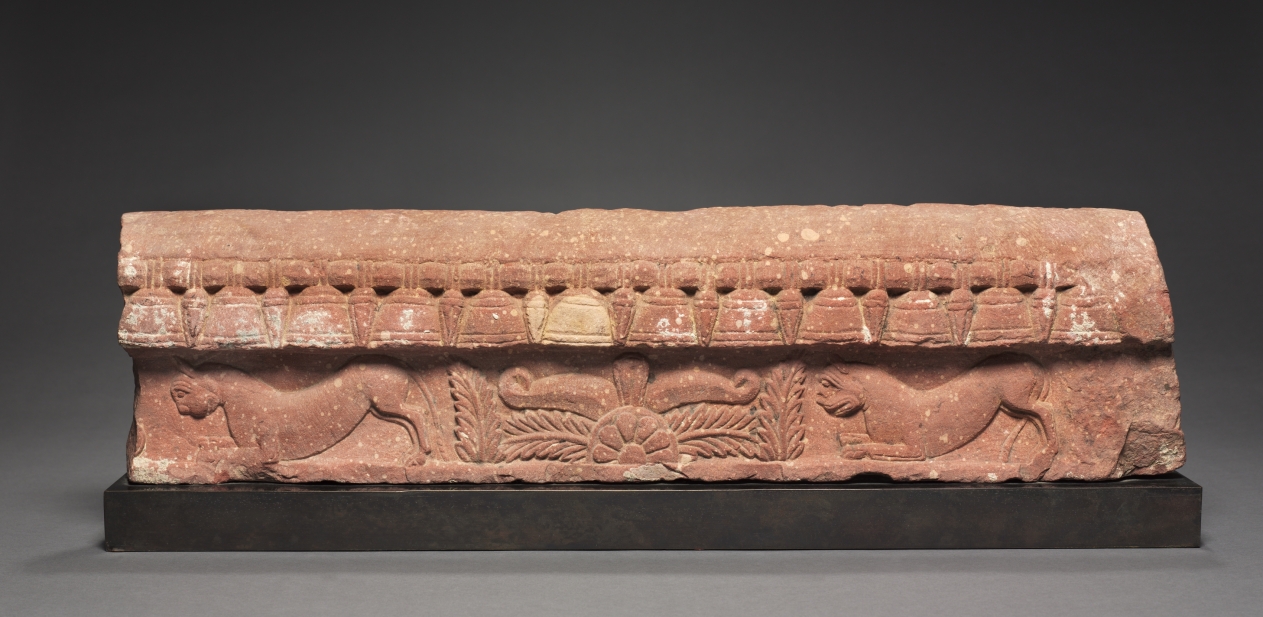
Section of a Coping Rail (1–200 CE) is in the Cleveland Museum of Art collection.
The work and its context
The museum's open-access catalogue describes the work:
The bells are intended to evoke the sounds that once accompanied the sacred space as much as visual ornamentation. A lion and a leonine figure with a human face bound enthusiastically as part of a parade of creatures who circle the monument in the proscribed clockwise direction. The exaggerated linear outlining of their features and the flatness of their bodies are stylistic features of relief sculpture from this period. The motif in the center has vegetal fronds symmetrically springing from a lotus rosette in the form of an auspicious symbol called shrivatsa, which is also found on the chests of Jinas-liberated beings of the Jain tradition-and the Hindu god Vishnu.
Object facts
- Title: Section of a Coping Rail
- Date: 1–200 CE
- Culture: India, Mathura, Kushan period
- Type: Stone
- Technique: sandstone
- Dimensions: Overall: 17.5 x 69 x 6.5 cm (6 7/8 x 27 3/16 x 2 9/16 in.)
- Collection: Indian Art - Kushan
- Department: Indian and Southeast Asian Art
- Accession number: 2011.145
Collection credit
Gift of Maxeen and John Flower in honor of Dr. Stanislaw Czuma
Further reading listed by the museum
- Czuma, Stanislaw J., and Rekha Morris. Kushan Sculpture: Images from Early India. Cleveland, OH: The Cleveland Museum of Art in cooperation with Indiana University Press, 1985.
- “Art of Asia Acquired by North American Museums, 2010-2011.” Archives of Asian Art, vol. 62, 2012, pp. 105–153.
View the collection record
See the museum's photographs and full catalogue entry. Catalogue text is reproduced from the Cleveland Museum of Art's open-access data, with HTML formatting removed. This object and its supplied image are designated CC0.
Sources
More in Lifestyle
Keep reading