Silk Decorative Tunic Band with a Hunter (700s): Art, History and Details
Silk Decorative Tunic Band with a Hunter at the Cleveland Museum of Art: 700s, Silk: complementary weft-faced twill with inner warps (samit). Explore the work's context, creator attribution and collection history.
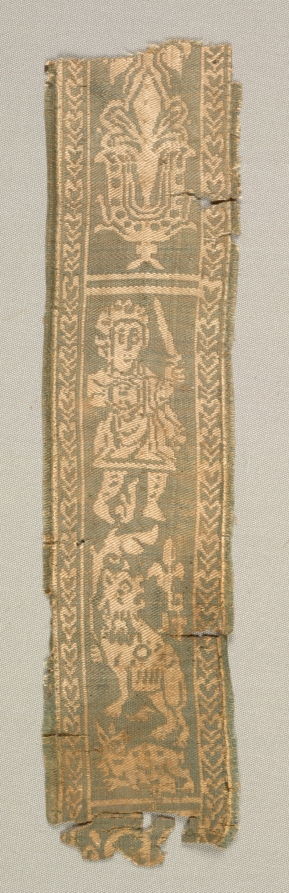
Silk Decorative Tunic Band with a Hunter (700s) is in the Cleveland Museum of Art collection.
The work and its context
The museum's open-access catalogue describes the work:
This prestigious silk band displays a stylized palmette leaf above a hunter who holds a sword and a shield and pursues a lion and a rabbit. Another fragment with Arabic script indicates Islamic manufacture. Green and ivory silk wefts (horizontal threads) dominate, interlaced by warps (vertical threads) in a diagonal twill weave. A second inner warp does not come to the surface. Such compound structures were woven on large looms with automatic pattern repetition, called drawlooms.
Object facts
- Title: Silk Decorative Tunic Band with a Hunter
- Date: 700s
- Culture: Egypt or Syria, Umayyad period (661–750) or Abbasid period (750–1258)
- Type: Textile
- Technique: Silk: complementary weft-faced twill with inner warps (samit)
- Dimensions: Overall: 27.3 x 6.7 cm (10 3/4 x 2 5/8 in.); Mounted: 34.9 x 14.3 cm (13 3/4 x 5 5/8 in.)
- Collection: T - Coptic
- Department: Textiles
- Accession number: 1939.505
Collection credit
Purchase from the J. H. Wade Fund
Further reading listed by the museum
- Los Angeles County Museum. 2000 Years of Silk Weaving: An Exhibition Sponsored by the Los Angeles County Museum in Collaboration with the Cleveland Museum of Art and the Detroit Institute of Arts. New York : E. Weyhe, 1944.
- Weibel, Adèle Coulin. Two Thousand Years of Textiles; The Figured Textiles of Europe and the Near East. New York: Published for the Detroit Institute of Arts [by] Pantheon Books, 1952.
- Katzenberg, Dena S. Blue Traditions; Indigo Dyed Textiles and Related Cobalt Glazed Ceramics from the 17th Through the 19th Century. [Baltimore]: Baltimore Museum of Art, 1973.
View the collection record
See the museum's photographs and full catalogue entry. Catalogue text is reproduced from the Cleveland Museum of Art's open-access data, with HTML formatting removed. This object and its supplied image are designated CC0.
Sources
More in Lifestyle
Keep reading