The court jester meets a Zangi dancing with joy, and learns from him that the cause of his happiness is his assignation with a woman who is the jester’s own wife, from a Tuti-nama (Tales of a Parrot):
The court jester meets a Zangi dancing with joy, and learns from him that the cause of his happiness is his assignation with a woman who is the jester’s own wife, from a Tuti-nama (Tales of a Parrot): Twenty-second Night at the Cleveland Mu
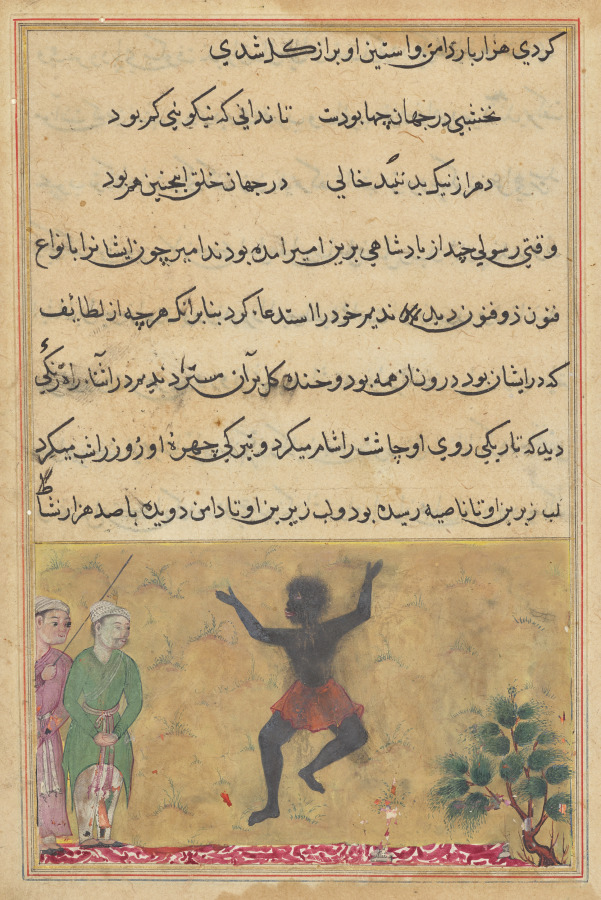
The court jester meets a Zangi dancing with joy, and learns from him that the cause of his happiness is his assignation with a woman who is the jester’s own wife, from a Tuti-nama (Tales of a Parrot): Twenty-second Night (c. 1560) is in the Cleveland Museum of Art collection.
The work and its context
The museum's open-access catalogue describes the work:
In the opening scene of the parrot’s bawdy story about a jester, who is shown wearing green on his way to perform at the court of the emir, he came upon an Ethiopian, known as Zangi, dancing by the side of the road. When he learned that the Zangi was overjoyed because he was planning to meet his beloved, the jester’s own wife, the jester was so distraught he was unable to perform, and the emir threw him in prison. The artist depicted the Zangi as described in the text as semi-wild with caricatured physical traits, uncovered head, and little clothing.
Object facts
- Title: The court jester meets a Zangi dancing with joy, and learns from him that the cause of his happiness is his assignation with a woman who is the jester’s own wife, from a Tuti-nama (Tales of a Parrot): Twenty-second Night
- Date: c. 1560
- Culture: Mughal India, court of Akbar (reigned 1556–1605)
- Type: Painting
- Technique: gum tempera, ink, and gold on paper
- Dimensions: Overall: 20.3 x 14 cm (8 x 5 1/2 in.); Painting only: 6.1 x 10.2 cm (2 3/8 x 4 in.)
- Collection: Indian Art
- Department: Indian and Southeast Asian Art
- Accession number: 1962.279.155.a
A detail from the museum
The tale references stereotypes about Africans that were current in India and Iran when the text was written.
Collection credit
Gift of Mrs. A. Dean Perry
Further reading listed by the museum
- Chandra, Pramod, and Daniel J. Ehnbom. The Cleveland Tuti-Nama Manuscript and the Origins of Mughal Painting. [Cleveland]: Cleveland Museum of Art, 1976.
- Seyller, John. “Overpainting in the Cleveland T̤ūtīnāma.” Artibus Asiae 52, no. 3/4 (1992): 283-318.
- Mace, Sonia Rhie, Dominique DeLuca, Dominique DeLuca, Mohsen Ashtiany, and Cleveland Museum of Art. Mughal Paintings: Art and Stories. [London] D Giles Limited, 2016.
View the collection record
See the museum's photographs and full catalogue entry. Catalogue text is reproduced from the Cleveland Museum of Art's open-access data, with HTML formatting removed. This object and its supplied image are designated CC0.
Sources
- The court jester meets a Zangi dancing with joy, and learns from him that the cause of his happiness is his assignation with a woman who is the jester’s own wife, from a Tuti-nama (Tales of a Parrot): Twenty-second Night (c. 1560; Cleveland 1962.279.155.a) — Cleveland Museum of Art
- Cleveland Museum of Art Open Access
More in Lifestyle
Keep reading