The Crucifixion of Saint Andrew (1606–7): Art, History and Details
The Crucifixion of Saint Andrew at the Cleveland Museum of Art: 1606–7, oil on canvas. Explore the work's context, creator attribution and collection history.
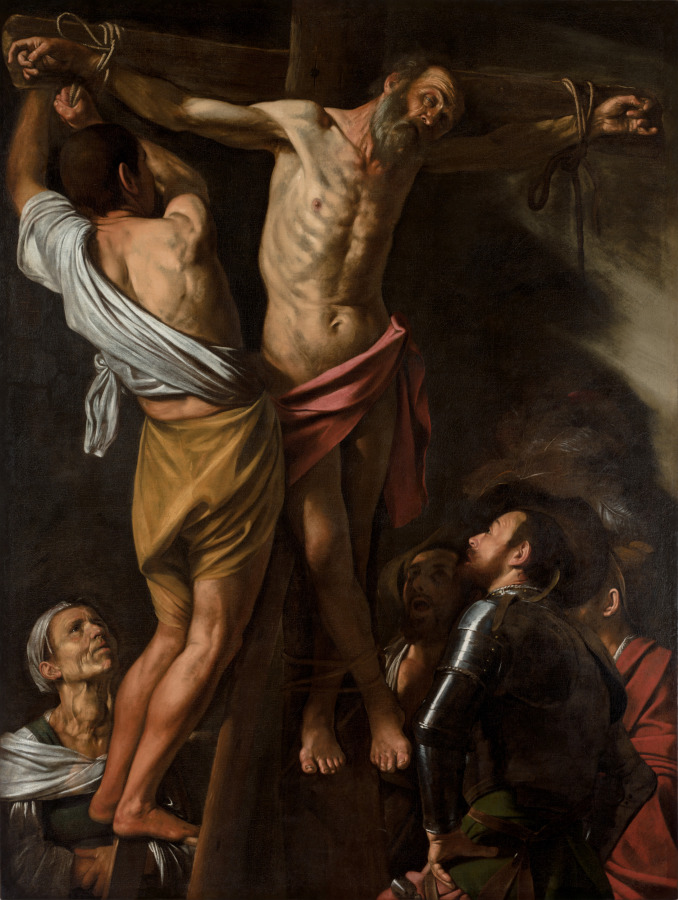
The Crucifixion of Saint Andrew (1606–7) is in the Cleveland Museum of Art collection. The museum's creator attribution is Caravaggio (Italian, 1571–1610).
The work and its context
The museum's open-access catalogue describes the work:
Saint Andrew’s efforts to introduce Christianity to Greece in the first century CE were met with hostility from local authorities. He was sentenced to die on the cross because he refused to acknowledge pagan gods. For two days, Andrew preached from his martyr’s station to an increasingly sympathetic crowd. Bowing to public demand, Andrew’s would-be executioners attempted to untie him, but their hands were mysteriously paralyzed. Andrew’s desire for martyrdom was thus fulfilled and he died enveloped in divine light. Caravaggio’s innovative interpretation involves the viewer more closely in the event by presenting the crucifixion as intimate and private, rather than as a gruesome public spectacle. Bold contrasts of light and dark suggest the presence of God. A masterpiece of Baroque painting, Caravaggio’s Crucifixion of Saint Andrew is the only altarpiece by the artist in America.
Object facts
- Title: The Crucifixion of Saint Andrew
- Date: 1606–7
- Creator attribution: Caravaggio (Italian, 1571–1610)
- Culture: Italy, Naples
- Type: Painting
- Technique: oil on canvas
- Dimensions: Framed: 233.5 x 184 x 12 cm (91 15/16 x 72 7/16 x 4 3/4 in.); Unframed: 202.5 x 152.7 cm (79 3/4 x 60 1/8 in.)
- Collection: P - Italian 16th & 17th Century
- Department: European Painting and Sculpture
- Accession number: 1976.2
A detail from the museum
Although Saint Andrew is typically associated with an X-shaped cross, here he is depicted on a standard vertical cross.
Collection credit
Leonard C. Hanna Jr. Fund
Further reading listed by the museum
- Zahn, Leopold, and Georg Kirsta. Caravaggio. Berlin: Albertusverlag, 1928.
- Longhi, Roberto. "Ultimi Studi Sul Caravaggio e la Sua Cerchia." Proporzioni I (1943): 5–63.
- García Chico, Esteban. "El palacio del Conde de Benavente" In Boletin de la Academia de Bellas Artes de la Purisma Concepcion de Valladolid IX (1946): 13–30.
View the collection record
See the museum's photographs and full catalogue entry. Catalogue text is reproduced from the Cleveland Museum of Art's open-access data, with HTML formatting removed. This object and its supplied image are designated CC0.
Sources
More in Lifestyle
Keep reading