The handmaiden again appeals for justice and the prince is led to the place of execution for the third time, from a Tuti-nama (Tales of a Parrot): Eighth Night (c. 1560): Art, History and Details
The handmaiden again appeals for justice and the prince is led to the place of execution for the third time, from a Tuti-nama (Tales of a Parrot): Eighth Night at the Cleveland Museum of Art: c. 1560, gum tempera, ink, and gold on paper. Ex
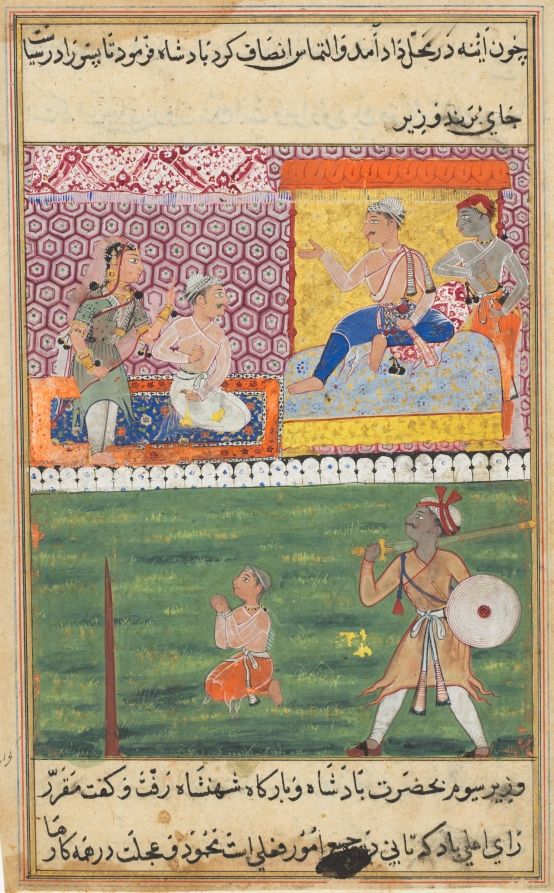
The handmaiden again appeals for justice and the prince is led to the place of execution for the third time, from a Tuti-nama (Tales of a Parrot): Eighth Night (c. 1560) is in the Cleveland Museum of Art collection. The museum's creator attribution is Gujarati (Indian, active 1550s-1590s).
The work and its context
The museum's open-access catalogue describes the work:
In the upper register, the king’s handmaiden appears at the court to once again ask that the young prince be executed. Having taken a temporary vow of silence, the prince is unable to defend himself. He kneels with his hands bound awaiting execution. For the third time, one of the king’s viziers will step in to stall the execution.
Object facts
- Title: The handmaiden again appeals for justice and the prince is led to the place of execution for the third time, from a Tuti-nama (Tales of a Parrot): Eighth Night
- Date: c. 1560
- Creator attribution: Gujarati (Indian, active 1550s-1590s)
- Culture: Mughal India, court of Akbar (reigned 1556–1605)
- Type: Painting
- Technique: gum tempera, ink, and gold on paper
- Dimensions: Painting only: 12.1 x 9.9 cm (4 3/4 x 3 7/8 in.); Overall: 20 x 13.4 cm (7 7/8 x 5 1/4 in.)
- Collection: Indian Art
- Department: Indian and Southeast Asian Art
- Accession number: 1962.279.61.b
A detail from the museum
A stake has been erected for the display of the prince’s severed head.
Collection credit
Gift of Mrs. A. Dean Perry
Further reading listed by the museum
- Chandra, Pramod, and Daniel J. Ehnbom. The Cleveland Tuti-Nama Manuscript and the Origins of Mughal Painting. [Cleveland]: Cleveland Museum of Art, 1976.
- Chandra, Pramod, and Daniel J. Ehnbom. The Cleveland Tuti-Nama Manuscript and the Origins of Mughal Painting. [Cleveland]: Cleveland Museum of Art, 1976.
- Seyller, John. “Overpainting in the Cleveland T̤ūtīnāma.” Artibus Asiae 52, no. 3/4 (1992): 283-318.
View the collection record
See the museum's photographs and full catalogue entry. Catalogue text is reproduced from the Cleveland Museum of Art's open-access data, with HTML formatting removed. This object and its supplied image are designated CC0.
Sources
More in Lifestyle
Keep reading