Three-pronged Vajra Pestle (Sankosho) (early 1300s): Art, History and Details
Three-pronged Vajra Pestle (Sankosho) at the Cleveland Museum of Art: early 1300s, gilt bronze. Explore the work's context, creator attribution and collection history.
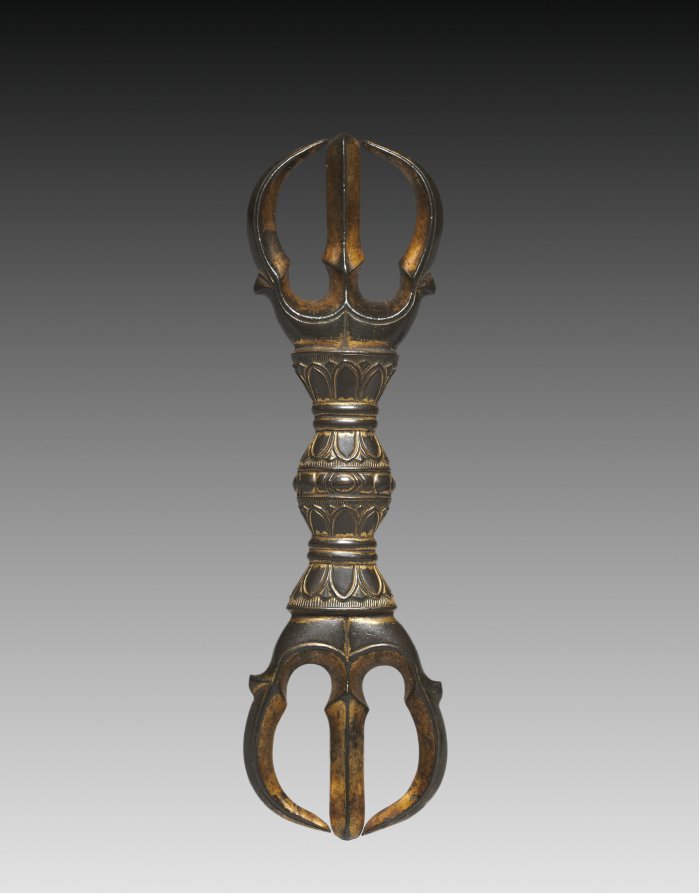
Three-pronged Vajra Pestle (Sankosho) (early 1300s) is in the Cleveland Museum of Art collection.
The work and its context
The museum's open-access catalogue describes the work:
Called a vajra in Sanskrit, a pestle of this kind is an Esoteric Buddhist ritual implement derived from the thunderbolt held by the Indian Vedic god Indra. The round forms along the center of the handle, known as demon eyes, are rather compressed in this example, and the lotus petal shapes near the prongs are quite sharply delineated.
Object facts
- Title: Three-pronged Vajra Pestle (Sankosho)
- Date: early 1300s
- Culture: Japan, Kamakura period (1185–1333)
- Type: Metalwork
- Technique: gilt bronze
- Dimensions: Overall: 17.5 x 5 cm (6 7/8 x 1 15/16 in.)
- Collection: Japanese Art
- Department: Japanese Art
- Accession number: 1974.264
A detail from the museum
The vajra is said to tear through ignorance like a powerful thunderbolt.
Collection credit
Gift of Dr. Richard G. Paley
View the collection record
See the museum's photographs and full catalogue entry. Catalogue text is reproduced from the Cleveland Museum of Art's open-access data, with HTML formatting removed. This object and its supplied image are designated CC0.
Sources
More in Lifestyle
Keep reading