Tiger in Wind (1800s): Art, History and Details
Tiger in Wind at the Cleveland Museum of Art: 1800s, hanging scroll; ink on paper. Explore the work's context, creator attribution and collection history.
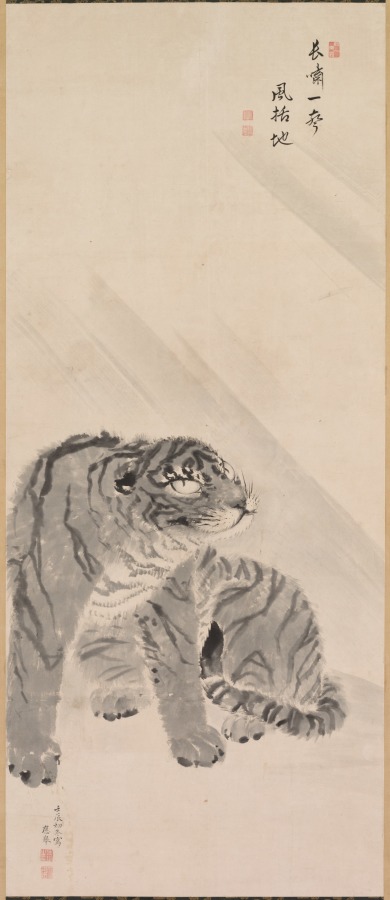
Tiger in Wind (1800s) is in the Cleveland Museum of Art collection. The museum's creator attribution is Maruyama Ōkyo (Japanese, 1733–1795).
The work and its context
The museum's open-access catalogue describes the work:
The seals appended to the inscription on this painting suggest that the text was brushed by Yūjō (1723–1773), an imperial prince who became a Buddhist monk and was abbot of Enman'in at Miidera. The line is from a poem attributed to a Yuan dynasty poet, Yu Ruyu (dates unknown), and describes the sound of a fierce wind lashing the ground. Wind is associated with the roar of the tiger. Yūjō was Maruyama Ōkyo's most important patron as a young artist, and this painting has a signature asserting that Ōkyo created it in 1772, the year before Yūjō's death. While Yūjō produced a preface for a now famous set of handscrolls he commissioned Ōkyo to paint, and a number of Ōkyo's compositions for Enman'in survive, this work would appear to be one imagining their relationship, as opposed to a genuine piece.
Object facts
- Title: Tiger in Wind
- Date: 1800s
- Creator attribution: Maruyama Ōkyo (Japanese, 1733–1795)
- Culture: Japan, Edo period (1615–1868) to Meiji period (1868–1912)
- Type: Painting
- Technique: hanging scroll; ink on paper
- Dimensions: Painting: 134.6 x 58 cm (53 x 22 13/16 in.); Mounted: 194 x 73 cm (76 3/8 x 28 3/4 in.)
- Collection: ASIAN - Hanging scroll
- Department: Japanese Art
- Accession number: 1971.232
Collection credit
Sundry Purchase Fund
Further reading listed by the museum
- Kathman, Barbara A. A Cleveland Bestiary. Cleveland, OH; Cleveland Museum of Art, 1981.
- Minamoto, Toyomune, and Hiroyuki Kano. Maruyama Ōkyo gashū. Kyōto-shi: Kyōto Shinbunsha, 1999.
- Cuningham, Michael R. Unfolding Beauty: Japanese Screens from the Cleveland Museum of Art. Cleveland, OH: Cleveland Museum of Art, 2001.
View the collection record
See the museum's photographs and full catalogue entry. Catalogue text is reproduced from the Cleveland Museum of Art's open-access data, with HTML formatting removed. This object and its supplied image are designated CC0.
Sources
More in Lifestyle
Keep reading