Tritoness or Scylla Relief Applique (late 200s BCE): Art, History and Details
Tritoness or Scylla Relief Applique at the Cleveland Museum of Art: late 200s BCE, bronze with copper inlays. Explore the work's context, creator attribution and collection history.
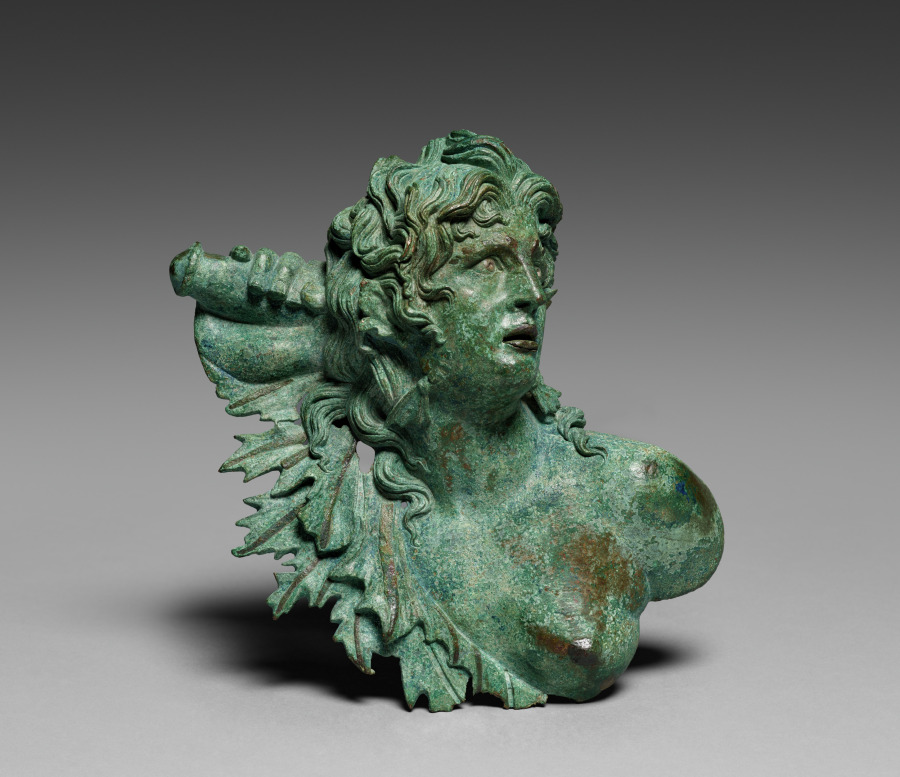
Tritoness or Scylla Relief Applique (late 200s BCE) is in the Cleveland Museum of Art collection.
The work and its context
The museum's open-access catalogue describes the work:
The seaweed garment, finned gills, and webbed ears give this female bust appliqué all the hallmarks of an ocean dweller. She may be a Tritoness, a minor goddess of the sea and the female counterpart to the more common Triton. However, her intense gaze and raised arm clutching perhaps the hilt of a sword suggest she may be Scylla, a sea monster that first appears in Homer’s Odyssey. Without the Tritoness’s fishtail or Scylla’s lower body made of dogs’ heads, it is difficult to differentiate. Certain features are highlighted with a copper inlay such as the lips, eyes, and gills.
Object facts
- Title: Tritoness or Scylla Relief Applique
- Date: late 200s BCE
- Culture: Greece, Hellenistic period
- Type: Metalwork
- Technique: bronze with copper inlays
- Dimensions: Overall: 22.4 x 24.5 x 7.8 cm (8 13/16 x 9 5/8 x 3 1/16 in.)
- Collection: GR - Greek
- Department: Greek and Roman Art
- Accession number: 1985.184
A detail from the museum
Mythological sea creatures became popular metal vessel decorations around the 2nd-century BCE.
Collection credit
Leonard C. Hanna Jr. Fund
Further reading listed by the museum
- The Cleveland Museum of Art. Handbook of the Cleveland Museum of Art. Cleveland, OH: The Cleveland Museum of Art, 1991.
- Walter-Karydi, Elena. "Skylla. Bilder und Aspekte des Mischwesens." Jahrbuch des Deutschen Archäologischen Instituts, 112: no. 6, 1997. pp 179-181.
- Walter-Karydi, Elena. “Dangerous is Beautiful: The Elemental Quality of a Hellenistic Scylla,” in Palagia and Coulson, eds. Regional Schools in Hellenistic Sculpture: Proceedings of an International Conference held at the American School of Classical Studies at Athens, March 15-17, 1996. 1998.
View the collection record
See the museum's photographs and full catalogue entry. Catalogue text is reproduced from the Cleveland Museum of Art's open-access data, with HTML formatting removed. This object and its supplied image are designated CC0.
Sources
More in Lifestyle
Keep reading