Votive Hanging with Image of Kannon (Kannon Kakebotoke) (mid- to late 1300s): Art, History and Details
Votive Hanging with Image of Kannon (Kannon Kakebotoke) at the Cleveland Museum of Art: mid- to late 1300s, Bronze with repoussé and etching. Explore the work's context, creator attribution and collection history.
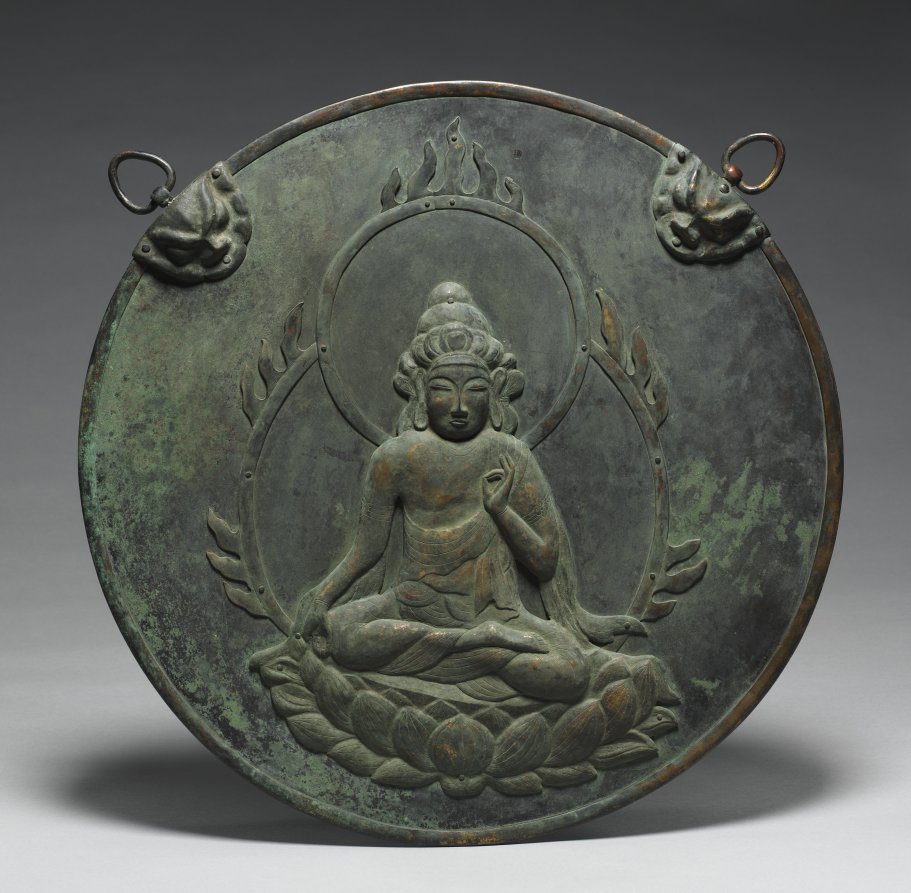
Votive Hanging with Image of Kannon (Kannon Kakebotoke) (mid- to late 1300s) is in the Cleveland Museum of Art collection.
The work and its context
The museum's open-access catalogue describes the work:
Kakebotoke (literally “hanging Buddhist deities”) like this appeared from the latter part of the Heian period. They often hung on the doors of a Shinto shrine hall to indicate the Buddhist manifestation of the god, or kami, inside, or along the eaves of a Buddhist temple hall to indicate the Buddhist deity celebrated there.
Object facts
- Title: Votive Hanging with Image of Kannon (Kannon Kakebotoke)
- Date: mid- to late 1300s
- Culture: Japan, Nanbokuchō period (1336–92)
- Type: Sculpture
- Technique: Bronze with repoussé and etching
- Dimensions: Diameter: 52.5 cm (20 11/16 in.)
- Collection: Japanese Art
- Department: Japanese Art
- Accession number: 1985.16
A detail from the museum
Here the deity Kannon sits on a lotus flower, a symbol of purity and enlightenment.
Collection credit
Leonard C. Hanna Jr. Fund
Further reading listed by the museum
- Turner, Evan H. “The Year in Review for 1984.” The Bulletin of the Cleveland Museum of Art 72, no. 2 (April 1985): 163–207.
- Cunningham, Michael R., Stanislaw J. Czuma, Anne E. Wardwell, and J. Keith Wilson. Masterworks of Asian Art. Cleveland, OH: The Cleveland Museum of Art, 1998.
View the collection record
See the museum's photographs and full catalogue entry. Catalogue text is reproduced from the Cleveland Museum of Art's open-access data, with HTML formatting removed. This object and its supplied image are designated CC0.
Sources
More in Lifestyle
Keep reading